Cardiac glycosides including digoxin have been used for the last century in the management of heart failure (HF) and are the only available oral agents with positive inotropic effects. Randomized studies using cardiac glycosides have been in ambulatory patients with HF and guidelines do not address their use in acutely decompensated HF or cardiogenic shock.1-4
We describe a single center experience of intravenous digoxin loading in decompensated HF patients with reduced ejection fraction (HFrEF) and low cardiac output with hemodynamic monitoring.
This was a single-center retrospective chart review of consecutive adults (age ≥18 years) admitted to our HF intensive care unit (ICU) between February and May of 2013 with an indwelling pulmonary artery (PA) catheter who received intravenous digoxin for low cardiac output (Fick cardiac index [CI] <2.2 L/min/m2). No patient was on an investigational device or pharmacotherapy. Digoxin was given as an intravenous loading dose of 0.5 mg followed by 0.25 mg in 6 hours and 0.25 mg 6 hours later. Patients subsequently continued an oral digoxin maintenance dose according to their renal function at the discretion of their treating physician. Titration of intravenous sodium nitroprusside, oral HF therapies, inotropes, and diuretics was at the discretion of the treating ICU physician. The pre-specified variable of interest was the change in CI at 24 hours from the first dose of digoxin loading as measured by the assumed Fick method by obtaining a mixed venous saturation (SvO2) from the distal port of the PA catheter and using an estimated oxygen consumption of 125 mL/min/m2; 24-hour pre- to post-digoxin changes were characterized by median (binomial-based 95% confidence interval), quartiles, and Wilcoxon signed-rank test with R version 4.5.1 (R Foundation for Statistical Computing). Other hemodynamic variables including mean arterial blood pressure, heart rate, mean right atrial, mean pulmonary artery, and mean pulmonary capillary wedge (PCWP) pressures were documented, when available. Safety observations included the occurrence of new atrial/ventricular arrhythmia at 72 hours as assessed by continuous telemetry review.
A total of 10 patients with a median age of 32.5 years, 9/10 male, 9 nonischemic and 1 ischemic etiology, left ventricular ejection fraction (LVEF) of 15% (range 12-20%), left ventricular end diastolic dimension of 7.15 cm (range 5.6-9.3 cm), and a baseline median CI of 1.45 L/min/m2 received digoxin loading (see Table 1). Four of ten patients had been on stable intravenous inotropes (dobutamine or milrinone) at the time of digoxin loading and the aim was to wean the inotropic support.
| Characteristic | Patient | |||||||||
|---|---|---|---|---|---|---|---|---|---|---|
| #1 | #2 | #3 | #4 | #5 | #6 | #7 | #8 | #9 | #10 | |
| Age | 34 | 51 | 25 | 38 | 31 | 29 | 49 | 22 | 49 | 19 |
| Sex | M | M | M | F | M | M | M | M | M | M |
| BMI | 54 | 37 | 51 | 36 | 47 | 22 | 35 | — | 30 | 37 |
| Ischemic origin of HF | N | N | N | Y | N | N | N | N | N | N |
| LVEF (%) | 15 | 15 | 15 | 15 | 12 | 12 | 20 | 12 | 20 | 18 |
| RV dysfunction | Mod to severe | Mod | Mod | Mod | Mild | Severe | Mild | Mod | Mild | Mild |
| LVEDD (cm) | 9.3 | 8.2 | 7.1 | 7.7 | 6.7 | 6.8 | 5.6 | 7.3 | 7.2 | 6.3 |
| Valvular disease | N | Severe MR | N | Mod MR | N | Mod MR/PR | N | Mod MR | Severe MR | Mod MR |
| Afib/Flutter | N | Y | N | N | N | N | N | N | N | N |
| Prior use of digoxin | N | N | N | Y | N | N | N | N | N | N |
| Concurrent use of vasodilator | Y | N | Y | Y | Y | Y | N | Y | Y | N |
| Concurrent use of diuretics | Y | Y | N | Y | Y | Y | Y | Y | Y | N |
| Concurrent use of IV inotropes | N | N | N | Y | N | Y | N | Y | N | Y |
Age (years), M = male, F = female, BMI = body mass index (kg/m2), HF = heart failure, Y = Yes, N = No, LVEF = left ventricular ejection fraction, RV = right ventricular, LVEDD = left ventricular end diastolic dimension, MR = mitral regurgitation, Mod = moderate, PR = pulmonary regurgitation, Afib/Flutter = atrial fibrillation/atrial flutter, IV = intravenous.
Figure 1 shows hemodynamic parameters before digoxin loading and after digoxin loading 24 hours after the first dose. After digoxin loading, median CI increased from 1.45 L/min/m2 at baseline to 2.70 L/min/m2, a median increase of 1.3 L/min/m2 (IQR 0.7-1.5; 95% confidence interval 0.5-1.8; p=0.002). The four patients on intravenous inotropic support were successfully weaned off at 24 hours following digoxin loading without any decrement in CI or SvO2. In 6/10 patients with evaluable data, the median PCWP decreased from 30 mm Hg down to 19 mm Hg. All patients were discharged from ICU with an oral digoxin maintenance dose. No patients had significant atrial or ventricular tachyarrhythmia or bradyarrhythmia during ICU stay.

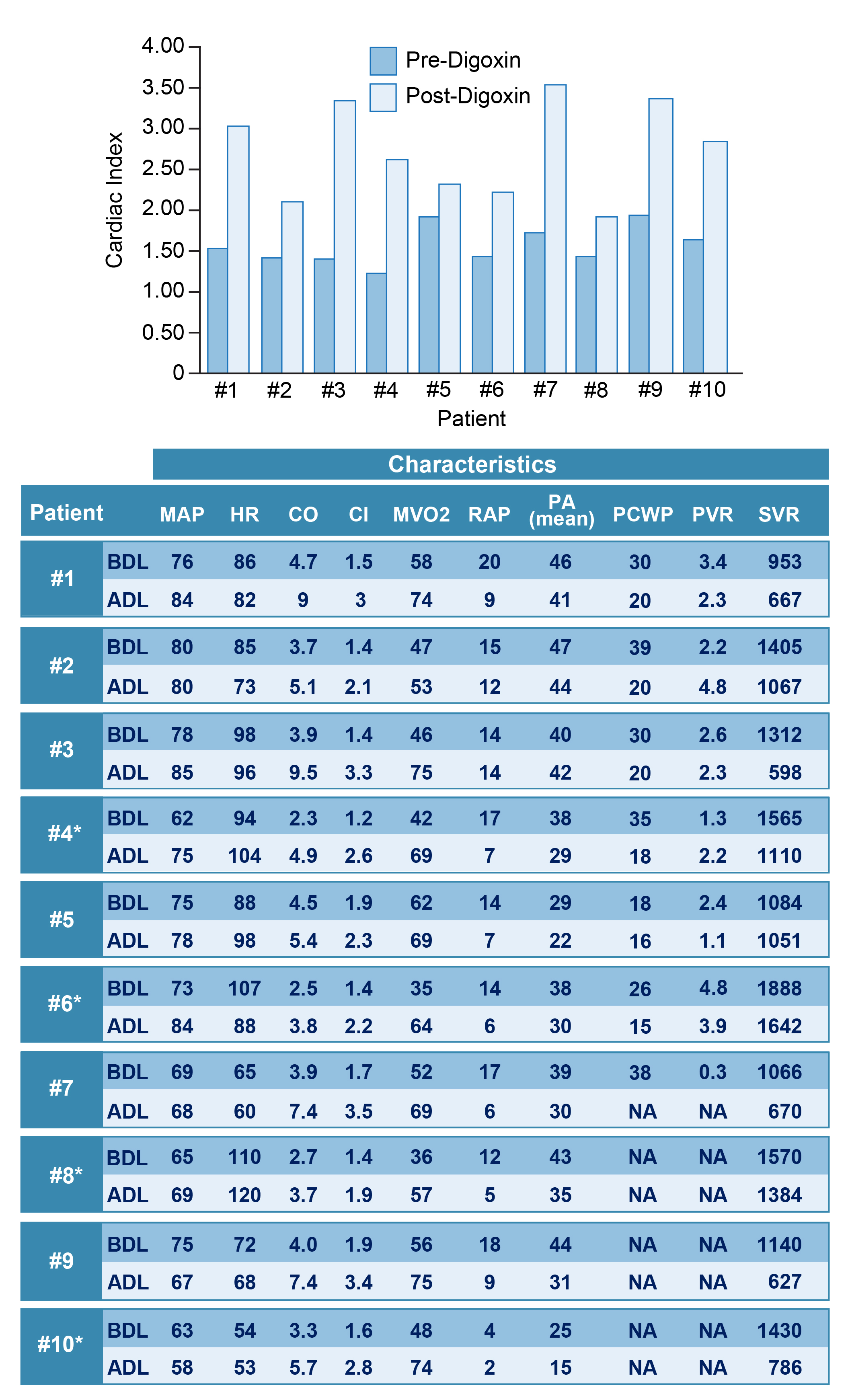
In this small patient cohort, intravenous digoxin was associated with an improved CI without significant arrhythmias and was associated with weaning of intravenous inotropes. The acute hemodynamic benefits of digoxin in patients with HF have been well described in several studies.5-7 Intravenous digoxin may be a useful adjuvant therapy in patients presenting with low cardiac output or cardiogenic shock who are unable to tolerate guideline directed medical therapy, fail to improve on or are intolerant of intravenous vasodilator therapy due to hypotension, or are unable to wean off traditional inotropes such as dobutamine or milrinone. The intended effect of loading digoxin intravenously is to achieve a therapeutic serum concentration rapidly in order to achieve the desired hemodynamic changes acutely. Notably, in our cohort, the degree of improvement in CI is larger than previously reported for digoxin in classic hemodynamic studies and likely represents a combination of the use of digoxin with vasodilators and decongestion with diuretics.
There are several important limitations to our findings. The cohort was small and mainly included younger patients limiting generalizability. This was an open label descriptive experience with no randomization to placebo and thus was an uncontrolled hemodynamic observation that only serves as hypothesis generating. Also, as stated above, the concurrent use of afterload reducing agents and diuretics would have impacted the hemodynamic effects described. For example, the degree of reduction in systemic vascular resistance in some patients would be mainly attributed to the use of vasodilators, and it is also well known that afterload reduction with the use of vasodilator therapy such as nitroprusside also improves CI. The most significant limitation to this series is the lack of documentation of specific concomitant medications and their doses between the baseline and 24-hour hemodynamic measurements. Unfortunately, the data needed to judge confounding are not available in this data set; this also includes electrolyte values, renal function, and intake and output including urine output. Lastly, we lack long-term data on the effects of digoxin loading on CI and HF outcomes.
In conclusion, the characterization of these hemodynamic findings suggests that, in HFrEF patients with low cardiac output, intravenous digoxin loading may have contributed to the rapid improvement in CI and may serve as a therapeutic option to facilitate weaning of intravenous inotropic therapy. A randomized clinical trial of digoxin in low cardiac output HF or cardiogenic shock is necessary to confirm these preliminary findings and demonstrate benefit and safety.