
Temporary mechanical circulatory support (MCS) is not a single therapy. Intra-aortic balloon counterpulsation, transvalvular microaxial pumps, left-atrial bypass systems, and venoarterial extracorporeal membrane oxygenation (VA-ECMO) generate different flows, correct different physiological deficits, and impose different vascular, hematologic, renal, and resource burdens. Their effects also depend on phenotype, timing, duration, weaning, and the rescue pathway available to the control group. Benefit in a selected patient with infarct-related cardiogenic shock should not be generalized to a hemodynamically compensated patient undergoing complex percutaneous coronary intervention (PCI).
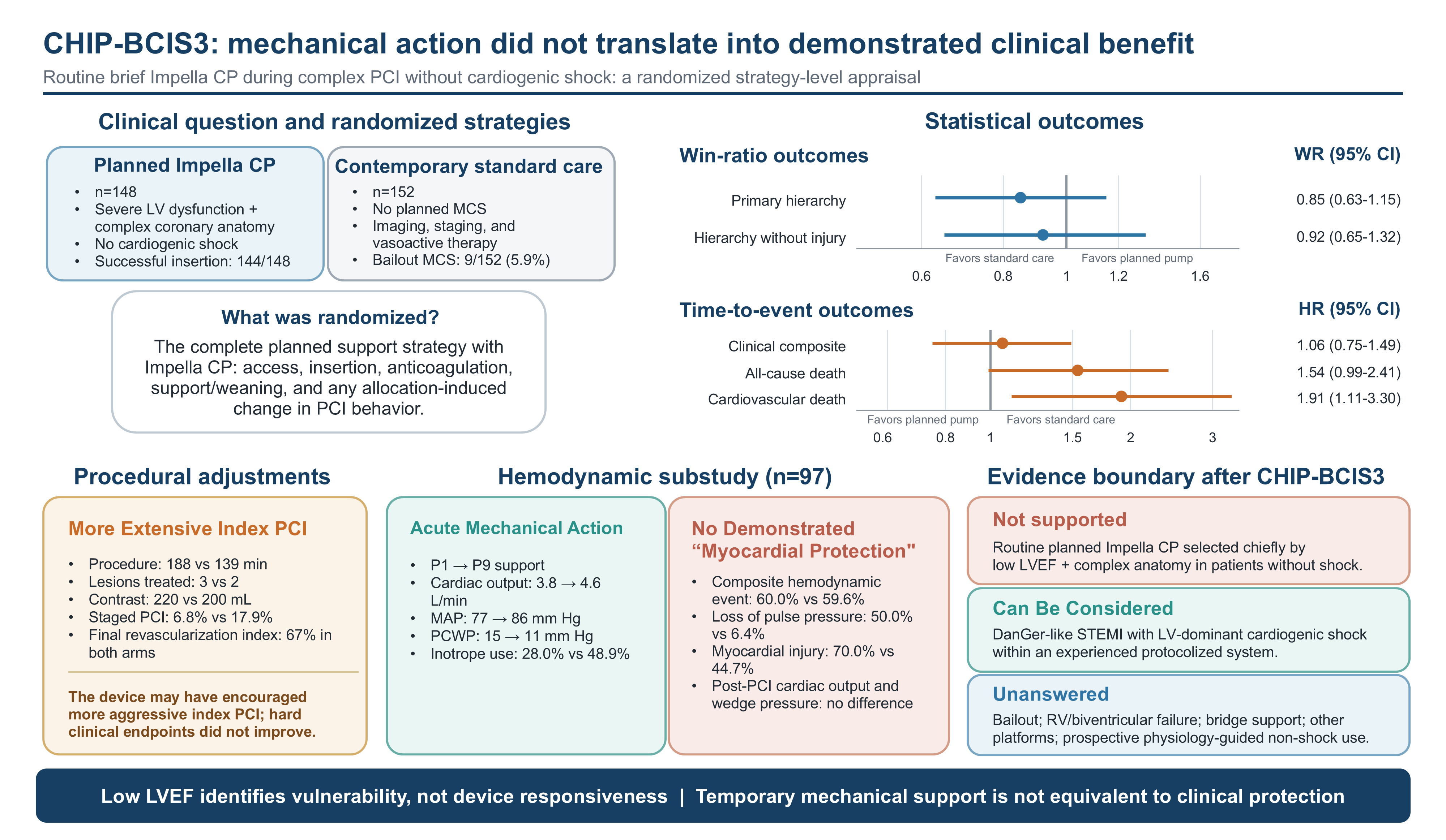
CHIP-BCIS3 therefore answered a narrower and clinically useful question: does routine, brief, planned Impella CP support improve patient-important outcomes during complex PCI in patients with severe left-ventricular (LV) dysfunction but without cardiogenic shock? The trial compared complete strategies, not isolated pump physiology. The randomized intervention included large-bore access, anticoagulation, insertion success or failure, support and weaning decisions, and any allocation-induced change in operator behavior. The comparator was an active contemporary strategy with imaging, staging, vasoactive treatment, and bailout MCS. We therefore use “planned hemodynamic support” rather than “protected PCI,” a term that presupposes the protection with temporary MCS.
What the trial showed
CHIP-BCIS3 was an investigator-led, publicly funded, open-label randomized superiority trial at 21 UK hospitals. From August 2021 through December 2024, 300 patients were assigned to planned microaxial-flow-pump support (n=148) or standard care without planned MCS (n=152); all had at least 12 months of follow-up, and median follow-up was 22 months.1,2 Eligibility combined extensive jeopardized myocardium, complex coronary anatomy, and severe LV dysfunction. Cardiogenic shock and acute ST-elevation myocardial infarction (STEMI) were excluded. Impella CP was inserted successfully in 144 of 148 assigned patients. Only 9 of 152 standard-care patients required bailout support (5.9%), confirming meaningful separation between a routine-support policy and an active pump-free strategy.
The primary endpoint was a hierarchical composite ordered as all-cause death, disabling stroke, spontaneous myocardial infarction, cardiovascular hospitalization, and periprocedural myocardial injury. Planned support won 36.6% of cross-arm comparisons, standard care won 43.0%, and 20.4% were tied, yielding a win ratio (WR) of 0.85 (95% confidence interval [CI], 0.63-1.15; P=.30).1 This is a negative superiority result, not proof of equivalence. The interval excludes the ambitious planning assumption of WR 1.60 and makes a large routine benefit implausible, while remaining compatible with a smaller benefit, no effect, or harm.
The conclusion was not created by the biomarker tier. Removing periprocedural myocardial injury produced a WR of 0.92 (95% CI, 0.65-1.32), and the conventional clinical composite excluding injury was nearly identical at 24 months (45.3% vs 45.4%; hazard ratio [HR], 1.06; 95% CI, 0.75-1.49).1 Injury occurred in 82 of 133 patients with data in the pump group and 62 of 124 controls (61.7% vs 50.0%). Because biomarker missingness differed between groups, this estimate warrants sensitivity analysis; nevertheless, excluding injury did not reveal a clinical advantage.
The pump changed the procedure, but not its clinical yield
Assignment altered what operators attempted. The index procedure lasted 188 versus 139 minutes, treated a median of three versus two lesions, used 220 versus 200 mL of contrast, and was staged less often with planned support (6.8% vs 17.9%).1 The device itself may therefore have encouraged a more aggressive index procedure: operators may have felt able, or obliged by learned practice, to treat more lesions in one sitting because transient deterioration seemed more tolerable. The open-label design cannot distinguish reassurance from local culture or fear of unsupported deterioration. Nonetheless, the 5.9% bailout rate shows that experienced teams could usually complete PCI without planned large-bore access.
The final strategy-level result is nevertheless clear. The overall revascularization index (change in BCIS jeopardy score divided by pre-procedure score × 100) was 67% in both groups and residual SYNTAX scores were 14 and 13, respectively. The index-procedure revascularization index was higher with planned support (67% vs 50% documented in the hemodynamic substudy), confirming more treatment at the initial sitting but similar overall revascularization.1,3
Hemodynamic substudy: mechanical action is not clinical protection
The invasive hemodynamic substudy helps separate pump-generated flow from protection of the patient.3,4 At baseline, participants were vulnerable but, on average, hemodynamically compensated: cardiac index was 2.10 L/min/m2, cardiac power 0.66 W, mean arterial pressure 78 mm Hg, and pulmonary capillary wedge pressure (PCWP) 14 mm Hg. This was not predominantly a congested, low-output population awaiting circulatory rescue.
Increasing support from the lowest to the highest pump setting increased measured cardiac output from 3.80 to 4.60 L/min, raised mean arterial pressure from 77 to 86 mm Hg, and reduced PCWP from 15 to 11 mm Hg. The 0.8-L/min figure is the increment between the lowest and highest pump settings; it is not the increment versus no support, because the lowest setting was already contributing flow. Console-displayed pump flow, incremental systemic output, reduced wall stress, and clinical protection are related but nonequivalent constructs.
The pump reduced inotrope use during PCI (28.0% vs 48.9%), confirming a favorable effect on this proximal endpoint. However, in the 97-patient hemodynamic substudy (50 pump, 47 standard care), the composite hemodynamic event occurred in 60.0% versus 59.6%, post-PCI changes in cardiac index and PCWP did not separate, and periprocedural myocardial injury occurred in 70.0% versus 44.7%.3 These injury figures are substudy-specific and therefore differ from the 61.7% versus 50.0% parent-trial estimate among patients with biomarker data. Loss of pulse pressure was also more common (50.0% vs 6.4%), but under continuous-flow support reduced pulsatility may reflect substitution for native ejection rather than failed perfusion. The defensible conclusion is narrow: the device produced acute physiological effects but did not attenuate the measured post-PCI hemodynamic surrogates or establish myocardial protection.
Methodological interpretation
The trial has important strengths: central randomization, high adherence, low crossover, blinded endpoint adjudication, complete 12-month follow-up, public funding, and a credible modern comparator.1,2 Its treatment-policy estimand is appropriate for practice. Failed insertion, access complications, bailout, and changes in procedural intensity are consequences of adopting the strategy, not extraneous noise.
Open-label behavior does limit mechanistic attribution. Allocation could influence lesion selection, staging, procedure duration, inotrope use, monitoring, and hospitalization thresholds. Randomization estimates the total strategy effect, but it cannot recover a “pure” biological unloading effect independent of these downstream changes.
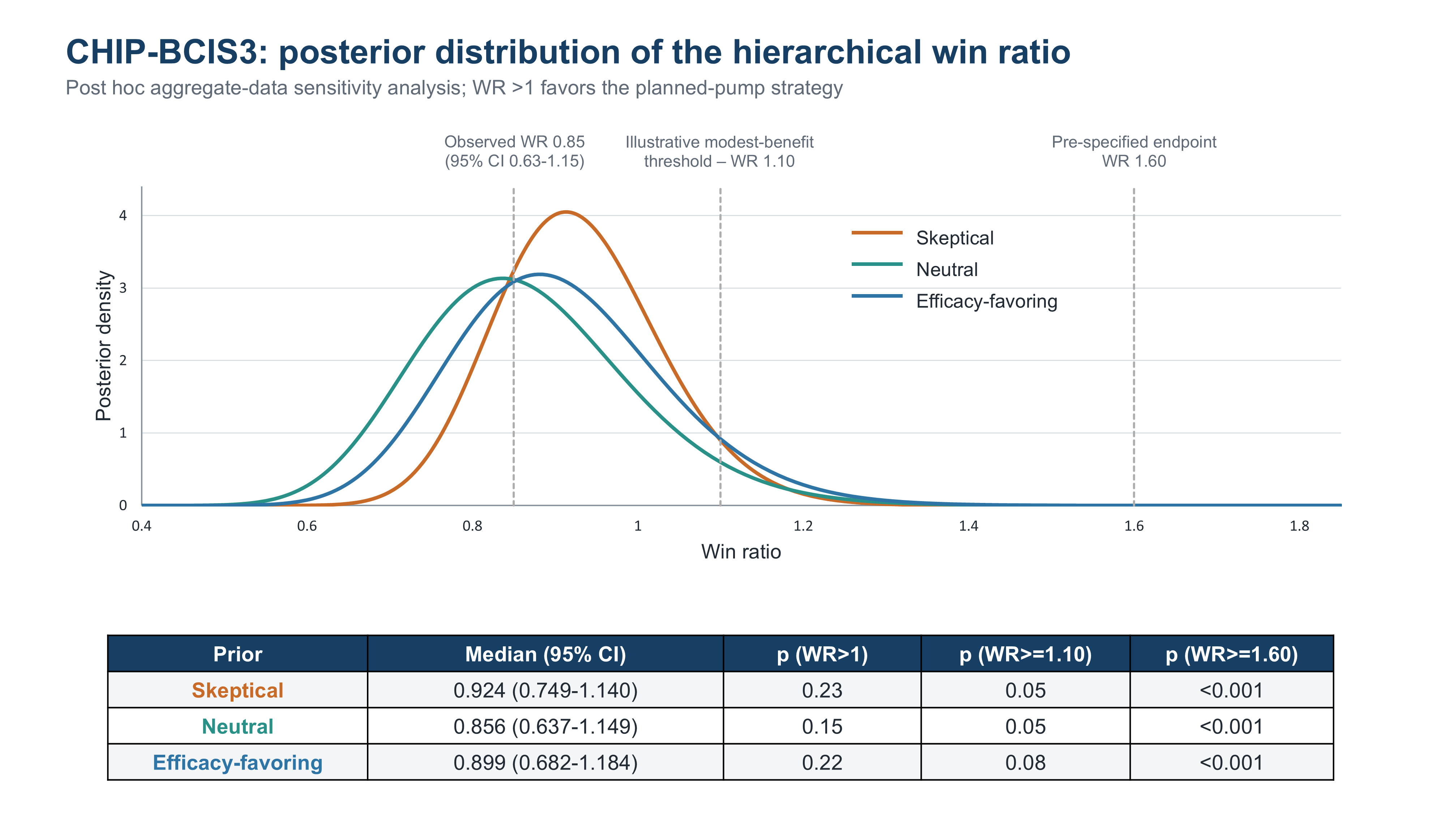
The hierarchical endpoint also requires precise language. A WR of 0.85 is not a 15% increase in patient-level risk; it is the ratio of pump-arm to control-arm wins among cross-arm pairs resolved by the prespecified hierarchy. Lower-tier wins are conditional on ties at all higher tiers. The trial had 85% power for WR 1.60, not for mortality, bleeding, vascular injury, renal events, or subgroup interactions. Figure 1 provides a post hoc decision-oriented translation: across skeptical, neutral, and efficacy-favoring priors, the probability of WR at least 1.10 is only about 5%-8%, and the probability of the 1.60 planning effect is <0.001. This supports the adoption decision but does not replace the prespecified analysis.

External validity is narrower than the broad label “high-risk PCI.” Women represented approximately 17%; procedures occurred in experienced UK centers with >90% intracoronary imaging, image-guided large-bore access, and ready bailout capability; and about half the cohort was enrolled by five centers.1 Outcomes could be less favorable where access planning and rescue expertise are weaker.
Mortality: a signal, not a causal verdict
All-cause death occurred in 47 patients assigned to planned support and 33 assigned to standard care (HR, 1.54; 95% CI, 0.99-2.41); cardiovascular death occurred in 36 and 20, respectively (HR, 1.91; 95% CI, 1.11-3.30).1 These findings should not be converted into the claim that the device “kills patients” or into a definitive number needed to harm. Mortality outcomes were secondary, multiplicity-unadjusted, and underpowered; late Kaplan-Meier estimates relied on progressively smaller risk sets; and the trial did not establish a causal pathway.
The apparent increase in cardiovascular mortality after approximately 18 months is particularly difficult to explain from a device used briefly around PCI. Delayed consequences of myocardial injury, a more intensive index procedure, subsequent heart failure, or arrhythmia are biologically possible, but no reported mediation analysis or cause-of-death detail can confirm them. Chance amplification in sparse late risk sets is at least as plausible. Fixed-horizon estimates, restricted mean survival time, timing and adjudicated mode of death, and longitudinal heart-failure treatment would help distinguish persistent biology from statistical noise.
The mortality direction remains decision-relevant because there was no efficacy advantage to offset uncertainty. Routine Impella CP adds device cost, large-bore arterial access, anticoagulation, and potential bleeding and vascular injury; in CHIP-BCIS3, both safety point estimates favored standard care. Renal deterioration is also an important concern across temporary-support trials, although CHIP-BCIS3 did not establish a clear excess of acute kidney injury and should not be presented as having done so. The strongest practical argument is therefore not proven lethality, but an invasive and costly strategy with unproven benefit and unresolved safety.
How CHIP-BCIS3 fits the randomized evidence
Table 1 organizes the randomized evidence by clinical setting rather than treating MCS as a biologically exchangeable class. In nonshock high-risk PCI, BCIS-1 did not meet its early primary endpoint, and its later mortality signal remained hypothesis-generating.5,6 PROTECT II showed stronger hemodynamic support with Impella 2.5 than with an intra-aortic balloon pump (IABP) but did not meet its 30-day primary endpoint and lacked an unsupported arm.7 PERSIST III found a SynFlow 3.0 microaxial pump noninferior to prophylactic VA-ECMO, but it was another supported-versus-supported comparison and cannot establish that routine support is better than no planned MCS.8 PROTECT IV and UNLOAD-CHIP will provide additional strategy-level evidence.9,10
| Trial (sample) | Setting and randomized comparison | Principal result | Key interpretive boundary |
|---|---|---|---|
| High-risk PCI studies | |||
| BCIS-1* 301 randomized5,6 | Planned IABP vs no planned IABP during high-risk PCI. | In-hospital/28-day MACCE: 15.2% vs 16.0%. | The early powered endpoint was neutral. A later mortality signal at median 51 months was not the original primary endpoint and remains hypothesis-generating. |
| PROTECT II* 452 randomized7 | Impella 2.5 vs IABP after the treating team had already judged support necessary. | 30-day major adverse events: 35.1% vs 40.1%; P=.227. Trial stopped early for futility. | No unsupported arm. Stronger intraprocedural hemodynamics and later per-protocol signals cannot replace the primary comparison. |
| PERSIST III* 222 randomized8 | SynFlow 3.0 microaxial pump vs prophylactic VA-ECMO during high-risk PCI in patients with LVEF ≤35%. | 30-day major adverse events: 7.3% vs 11.5%; adjusted difference −4.6% (95% CI, −12.6 to 3.5); noninferiority P<.001. | A supported-vs-supported noninferiority trial. It does not test whether routine support is superior to no planned MCS. |
| CHIP-BCIS3 300 randomized1,2 | Planned Impella CP vs contemporary standard care without planned MCS in complex PCI without cardiogenic shock. | Primary hierarchy: WR 0.85 (95% CI, 0.63-1.15); P=.30. Bailout MCS: 5.9%. | Directly tests a routine-support policy. Negative for superiority, not proof of equivalence; a large planning effect (WR 1.60) is implausible. |
| PROTECT IV* Target n=1,2529 | Impella CP/2.5-supported PCI vs no planned MCS in high-risk PCI with reduced LV function. | Ongoing; enrollment complete and follow-up in progress. | A strategy-level comparison with an unsupported control; phenotype, endpoint, and procedural differences will determine comparability with CHIP-BCIS3. |
| UNLOAD-CHIP* Initial n=98; adaptive10 | PulseCath iVAC2L vs standard care without planned MCS in SCAI A-B CHIP PCI with severe LV dysfunction. | Ongoing; 30-day composite includes death, progression to SCAI C-E, ventilation, renal-replacement therapy, and arrhythmic arrest. | An investigator-initiated, manufacturer-subsidized adaptive trial of a different pump platform; initial assumptions are ambitious. |
| Cardiogenic shock / LV venting studies | |||
| IABP-SHOCK II* 600 randomized11 | Routine IABP vs no routine IABP in revascularized acute myocardial infarction shock. | 30-day death: 39.7% vs 41.3%. | Did not support routine IABP in a broad AMI-shock population; timing relative to revascularization varied. |
| IMPRESS 48 randomized12 | Impella CP vs IABP in extremely severe, predominantly post-arrest AMI shock. | 30-day death: 46% vs 50%. | Severely underpowered and dominated by neurologic risk; cannot establish comparative survival. |
| DanGer Shock* 360 randomized; 355 analyzed13 | Impella CP plus standard care vs standard care in selected STEMI with LV-dominant cardiogenic shock. | 180-day death: 45.8% vs 58.5%; HR 0.74 (95% CI, 0.55-0.99). Safety composite: 24.0% vs 6.2%. | Phenotype- and system-specific benefit with more adverse events and renal-replacement therapy. Enrollment of 360 patients took >10 years, underscoring selection. |
| ECLS-SHOCK 420 randomized; 417 analyzed14 | Routine early VA-ECMO vs usual care with selective rescue in AMI shock. | 30-day death: 47.8% vs 49.0%; bleeding 23.4% vs 9.6%. | Routine early ECMO did not improve survival and increased bleeding/vascular burden. Few ECMO patients received active LV unloading. |
| ECMO-CS 122 randomized; 117 analyzed15 | Immediate VA-ECMO vs selective rescue in severe mixed-etiology cardiogenic shock. | Composite: 63.8% vs 71.2%, not significant; death: 50.0% vs 47.5%. | Selective rescue was the intended comparator, not contamination. The composite counted downstream MCS asymmetrically. |
| Altshock-2* 101 randomized16 | Early IABP plus care vs care in heart-failure-related shock eligible for heart replacement. | 60-day primary success: 81% vs 75%; stopped for futility. | Bridge-oriented, relatively low-lactate phenotype; not a smaller DanGer Shock population. |
| STEMI-DTU* 527 randomized17 | Impella CP plus mandated unloading interval, delayed reperfusion, and prolonged support vs immediate PCI in anterior STEMI without shock. | Infarct size: 30.8% vs 31.9% of LV mass; difference −1.1 points (95% CI, −4.2 to 2.0). Major bleeding/vascular complications: 34.0% vs 6.0%. | Tested a multi-component strategy rather than isolated unloading; did not show the prespecified infarct-size benefit and increased access-related harm. |
| EARLY-UNLOAD 116 randomized18 | Routine early transseptal left-atrial drainage vs rescue drainage after VA-ECMO initiation. | 30-day death: 46.6% vs 44.8%; pulmonary congestion cleared about 2 days earlier. | About half of controls were drained. The trial tested a timing policy, not unloading vs none. |
| EVOLVE-ECMO 60 randomized19 | Early vs conventional left-atrial venting during VA-ECMO with LV overload. | ECMO weaning: 70.0% vs 76.7%; survival to discharge: 53.3% vs 50.0%. | Between-group congestion change was not significant; within-group improvement is not a treatment effect. |
*Industry funded, cofunded, or supported through an unrestricted manufacturer grant/subsidy, as reported in the publication or trial registry. Ongoing trials have no outcome result. Data are shown on each trial’s native endpoint and time horizon; no pooled MCS-class effect is implied. AMI indicates acute myocardial infarction; CI, confidence interval; HR, hazard ratio; IABP, intra-aortic balloon pump; LV, left ventricular; LVEF, left-ventricular ejection fraction; MACCE, major adverse cardiac and cardiovascular events; MCS, mechanical circulatory support; PCI, percutaneous coronary intervention; SCAI, Society for Cardiovascular Angiography and Interventions; STEMI, ST-elevation myocardial infarction; VA-ECMO, venoarterial extracorporeal membrane oxygenation; and WR, win ratio.
Cardiogenic shock and LV venting trials define different boundaries. IABP-SHOCK II, IMPRESS, ECLS-SHOCK, ECMO-CS, and Altshock-2 did not establish broad routine benefit in their respective populations.11,12,14-16 DanGer Shock is the important exception: in a highly selected STEMI-related, LV-dominant shock phenotype, Impella CP reduced 180-day mortality but increased serious adverse events and renal-replacement therapy.13 DanGer enrolled 360 patients over a period of more than 10 years, whereas CHIP-BCIS3 enrolled 300 in approximately 40 months. Faster enrollment supports the practical relevance of CHIP-BCIS3 to the tested UK nonshock workflow; it does not make the trials contradictory or allow transport of benefit across phenotypes. DanGer’s slow recruitment underscores how selected its eligible shock population was.
Similarly, STEMI-DTU tested a package of unloading, delayed reperfusion, and prolonged support, while EARLY-UNLOAD and EVOLVE-ECMO tested routine versus selective left-atrial drainage after VA-ECMO had already begun.17-19 These studies reinforce a recurrent lesson: improving flow, pressure, or congestion does not guarantee improved survival or recovery.
Implications
The de-implementation message is narrow but actionable: severe LV dysfunction plus complex coronary anatomy should not function as an automatic indication for planned Impella CP in patients without shock. CHIP-BCIS3 does not refute bailout support, DanGer-like infarct-related shock, right-ventricular or biventricular failure, bridge strategies, or other pump platforms. It shows that routine prophylaxis exposes all selected patients before it is known who will deteriorate, while only a small minority required bailout.
Future trials should enrich for a measured, modifiable physiological deficit rather than select only by left ventricular ejection fraction (LVEF) and anatomy. Candidate markers include low cardiac power, high filling pressure, limited reserve, or predicted intolerance of a prespecified ischemic burden, but none is currently a validated treatment-effect marker. Protocols should define procedural intensity, ischemic dose, support exposure, weaning, bailout, and patient-important safety endpoints, including cost.
CHIP-BCIS3 demonstrated mechanical action without demonstrated clinical protection. Low LVEF identifies vulnerability, not device responsiveness. Until a prospectively defined physiology-selected subgroup shows net benefit, planned Impella CP should not be routine in CHIP-BCIS3-like patients.