
Introduction
A recent analysis found that almost one-half of U.S. counties, representing approximately 22 million residents, had no cardiologists.1 The average round-trip distance to the nearest cardiologist in these counties was 87 miles. These residents had higher morbidity and mortality. This access disparity is magnified with advanced specialty conditions such as hypertrophic cardiomyopathy (HCM). Septal myectomy (SM) is indicated in symptomatic obstructive HCM (oHCM) refractory to medical therapy. A close association between surgical volume and outcomes has been established with a vast difference between high- and low-volume centers.2-5 However, the number and geographic concentration of high-volume centers may limit access, with 97% located in large metropolitan areas.2 Outcomes reported in national volume-based studies may be disproportionately influenced by a small number of centers at the extremes of procedural volume. In this study we evaluated whether SM could be performed safely and effectively at a lower-volume center. All elective primary SM procedures, as well as most urgent SM procedures and SM performed in conjunction with other surgeries, were assigned to a single operator because of the lower volumes. Our community healthcare network serves a local medium-sized metropolitan area, and a broader rural community.
Methods
We retrospectively reviewed all SM performed from 2006 to 2023 by a single primary operator at our healthcare network. Since the inception of our surgical HCM program in 2006, >95% of all SM were performed by a single operator. The institutional review board approved the study. Baseline comorbidities were defined as those present before surgery. Intraoperative gradients included provokable gradients following beta-agonist administration. Postoperative gradients were assessed at rest and with Valsalva. One-year mortality included inpatient mortality. Vital status at 1 year was documented for all patients, with no patients lost to follow-up before the 1-year endpoint. In-hospital complications were independently reviewed by two physicians. Neurologic sequelae following stroke were assessed based on neurology and cardiology office visits. Pacemaker complications assessed included infection or need for upgrade to cardiac resynchronization therapy (CRT). Patient distance to our hospital was calculated based on residential address.
Categorical variables were reported as frequencies and percentages, and continuous variables as mean ± standard deviation or median (interquartile range [IQR]) based on distribution of the data. Continuous variables were compared using the Student t-test for normally distributed data and the Wilcoxon rank-sum test for nonnormally distributed data. Categorical variables were compared using Fisher’s exact test. The primary analysis was a qualitative comparison with the 4 most-cited national studies, using data from centers at the highest quantile of volume as well as centers with comparable volume. Statistical analyses were performed using JMP 17.0 (SAS Institute).
Results
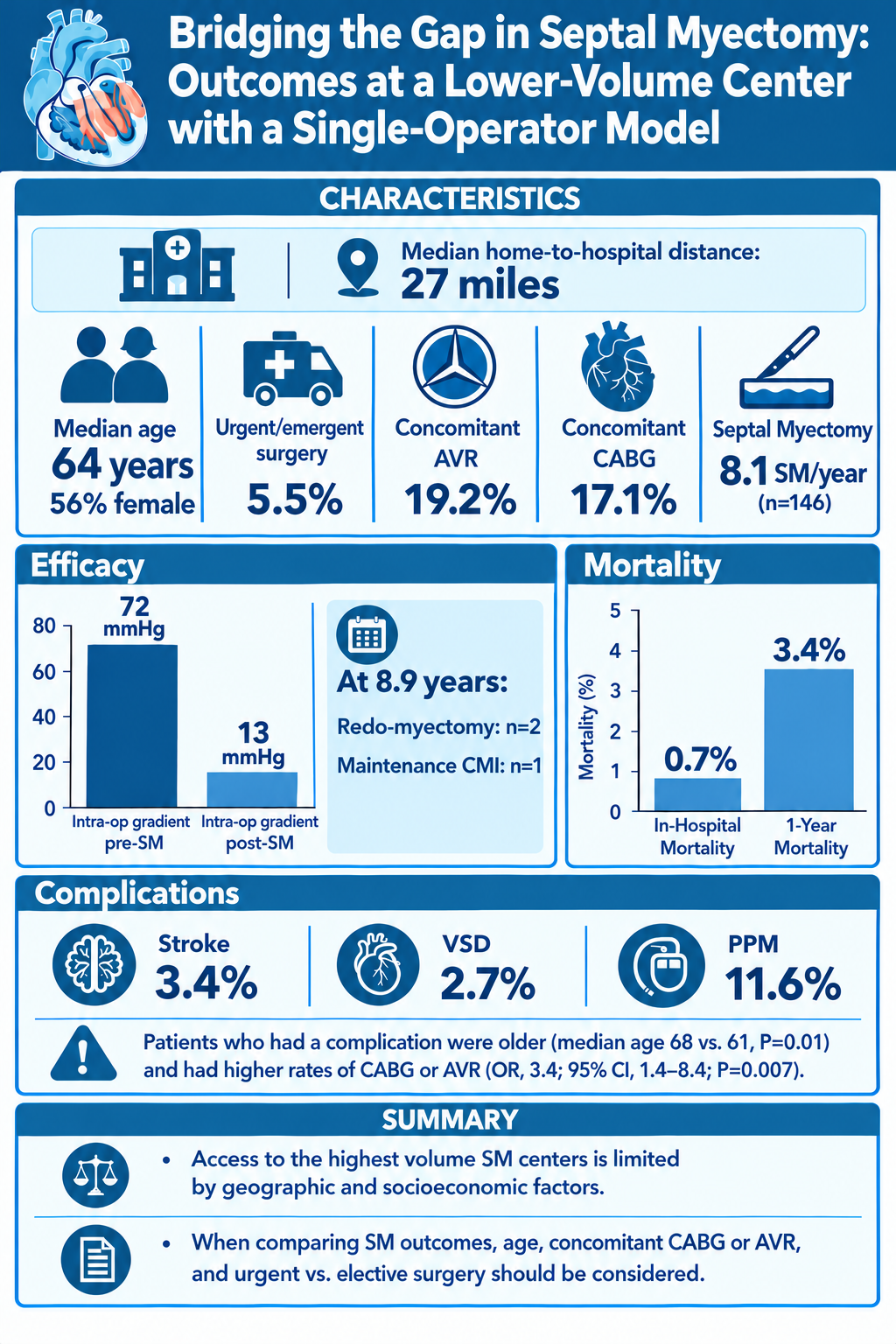
A single primary operator performed 146 SM with an average case volume of 8.1 per year (Table 1). Surgery was urgent or emergent in 5.5% of cases. The inpatient and 1-year mortality were 0.7% and 3.4%, respectively. Of the five 1-year deaths, one was attributable to stroke during the index procedure, two to out-of-hospital cardiac arrest, and two to unknown causes. Intraoperative gradients improved from 72 to 13 mmHg, and New York Heart Association (NYHA) class improved from 2.9 to 1.2. At a median follow-up of 8.9 years (IQR, 5.4-11.6 years), 2 patients required redo-myectomy, and 1 patient was receiving maintenance cardiac myosin inhibitor (CMI) therapy. At a median of 2.0 years after surgery (IQR, 0.6-3.1 years), echocardiography demonstrated a peak resting or Valsalva gradient >30 mmHg in 7.3% of patients (9 out of 123), of whom 5 were symptomatic.
| Characteristic | Value |
|---|---|
| Age, years | 64 (IQR, 55-72) |
| Female | 81 (55.5%) |
| Atrial fibrillation | 33 (22.6%) |
| Hypertension | 105 (71.9%) |
| Diabetes | 36 (24.7%) |
| CAD | 53 (36.3%) |
| COPD | 16 (11.0%) |
| BMI, kg/m2 | 32.4 ± 6.6 |
| GFR <60 mL/min/1.73 m2 | 25 (17.1%) |
| Patient distance from hospital, miles | 27 (14-52) |
| Surgery | |
| Mitral valve repair | 18 (12.3%) |
| MVR | 15 (10.3%) |
| AVR | 28 (19.2%) |
| CABG | 25 (17.1%) |
| Urgent or emergent surgery | 8 (5.5%) |
| Myectomy weight, grams | 4.7 ± 1.9 (n=136) |
| Efficacy | |
| Pre-NYHA class | 2.9 ± 0.5 (n=144) |
| Post-NYHA class | 1.2 ± 0.4 (n=134) |
| Intraoperative gradient pre-myectomy, mmHg | 72.4 ± 39.2 (n=125) |
| Intraoperative gradient post-myectomy, mmHg | 12.7 ± 7.7 (n=124) |
| Postoperative gradient, mmHg | 13.9 ± 9.8 (n=123) |
| Postoperative echocardiography time from surgery, years | 2.0 (IQR, 0.6-3.1) |
| Safety | |
| In-hospital mortality | 1 (0.7%) |
| 30-day mortality (including in-hospital) | 3 (2.1%) |
| 1-year mortality | 5 (3.4%) |
| Stroke | 5 (3.4%) |
| VSD | 4 (2.7%) |
| PPM | 17 (11.6%) |
| Any complication (stroke or VSD or PPM) | 25 (17.1%) |
| Dialysis | 1 (0.7%) |
| LOS, days | 5 (IQR, 4-8) |
Data are presented as mean ± SD for normally distributed continuous variables, median (IQR) for nonnormally distributed continuous variables, and n (%) for categorical variables. The denominator for individual variables may vary because of missing data and is documented. AVR, aortic valve replacement; BMI, body mass index; CABG, coronary artery bypass grafting; CAD, coronary artery disease; COPD, chronic obstructive pulmonary disease; GFR, glomerular filtration rate; IQR, interquartile range; LOS, length of stay; MVR, mitral valve replacement; NYHA, New York Heart Association; PPM, permanent pacemaker; SD, standard deviation; VSD, ventricular septal defect.
Patients who experienced SM complications including stroke, ventricular septal defect (VSD), or need for permanent pacemaker (PPM) were older (median age 68 vs. 61, P=0.01) and had higher rates of concomitant coronary artery bypass grafting (CABG) or aortic valve replacement (AVR; OR, 3.4; 95% CI, 1.4–8.4; P=0.007) compared to those without complications. Patients with complications had a median follow-up of 7.0 years (IQR, 4.6-11.6 years). All patients with VSD had repairs of which 3 of 4 occurred during index surgery, and all were free of heart failure manifestations. All patients with stroke were free of neurologic deficits. All patients with PPM were free of infection, and one patient required CRT upgrade. When comparing the initial 73 cases with the subsequent 73 cases, median age was 59 years (IQR, 52-70) vs. 65 years (IQR, 59-73), the incidence of PPM implantation was 10 vs. 7 cases, VSD occurred in 2 vs. 2 cases, stroke occurred in 3 vs. 2 cases, and 1-year mortality was 2 vs. 3 cases, respectively.
Nine patients resided outside the state, including eight from neighboring states. The median distance from patients’ residential addresses to our institution was 27 miles (IQR, 14–52 miles).
Discussion
The clinical care in HCM is multifaceted. The skillset for certain aspects is easier to disseminate, including genetic testing and family screening, provocative testing and medical therapy for oHCM, sudden cardiac death risk stratification including cardiac MRI, and shared decision making. Expertise in these areas can be supported by training in Advanced Heart Failure and Advanced Cardiac Imaging, as well as a culture of continued medical education. The advent of social media has democratized the dissemination of knowledge. In contrast, procedural expertise is more challenging to disseminate. Certain procedures relevant to HCM such as implantable cardioverter-defibrillator and catheter ablation of arrhythmia are commonly performed procedures, and procedural volumes within community healthcare networks may reach or exceed those of academic institutions in major metropolitan areas. However, the volume of septal reduction therapies remains considerably more limited. CMI are changing the treatment landscape by providing effective therapy for refractory oHCM and targeting disease pathophysiology with potential myocardial remodeling benefits. Nevertheless, SM remains an important option in those with inadequate response to CMI, those requiring concomitant cardiac surgery, and patient preference.
In this study we demonstrate that SM performed by a single operator at a lower-volume center can reach an acceptable level of safety and efficacy. The study by Altibi et al.2 may provide the most comparable benchmark given the similarities in patient populations and procedural characteristics. Our mortality rates were comparable to those of the highest-volume group in that study (Table 2). In contrast, the studies by Holst et al.3 and Wei et al.4 excluded patients undergoing emergent surgery and those with aortic stenosis and AVR. The study by Kim et al.5 defined the high-volume group as the top tertile of hospitals by procedural volume, representing a broader volume category than the more selective high-volume cohorts used in other studies.
| LVHN | Altibi 20232 | Holst 20223* | Wei 20194* | Kim 20165 | |
|---|---|---|---|---|---|
| Comparison with centers in the highest quantile of volume | |||||
| % of hospitals in top quantile | 3.9% | 2% | 5% | 33.3% | |
| Annual SM volume, cases/year | 8.1 | 47 | >10 | >20 | Not reported |
| Age, years | 64 (IQR, 55-72)† | 59 ± 11.7 | 58 (IQR, 48-66) | 57 (IQR, 47-65) | 55.7 ± 19.6 |
| Female | 55.5% | 52.9% | 47.3% | 46.4% | 55.7% |
| Inpatient mortality | 0.7% | 2.4% | 3.8% | ||
| 30-day mortality | 2.1% | 2% | 0.9% | 1.1% | |
| LOS, days | 5 (IQR, 4-8) | 9.7 ± 8.5 | 7 (IQR not reported) | ||
| CABG | 17.1% | 15.2% | 8.2% | 7.6% | 18% |
| AVR | 19.2% | 18.7% | 0% | 1.5% | |
| MVR | 10.3% | 9.2% | 6.3% | 7.4% | |
| Stroke | 3.4% | 1.9% | 1.9% | ||
| PPM | 11.6% | 6.9% | 5.1% | 8.9% | |
| VSD | 2.7% | 2.0% | 0.4% | 0.2% | |
| Comparison with centers with similar volume | |||||
| % of hospitals in quantile | 16% | 2% | 95% | 33.3% | |
| Annual SM volume, cases/year | 8.1 | 12.1 | 5-10 | <20 | Not reported |
| Age, years | 64 (IQR, 55-72)† | 58.6 ± 14.7 | 58 (IQR, 48-67) | 60 (IQR, 51-69) | 59.9 ± 17.3 |
| Female | 55.5% | 54.7% | 48.6% | 54.8% | 65.6% |
| Inpatient mortality | 0.7% | 3.9% | 9.6% | ||
| 30-day mortality | 2.1% | 3.3% | 2.0% | 3.0% | |
| LOS, days | 5 (IQR, 4-8) | 9.4 ± 8.3 | 8 (IQR not reported) | ||
| CABG | 17.1% | 13.0% | 10.2% | 17.9% | 24.8% |
| AVR | 19.2% | 20.1% | 0% | 1.0% | |
| MVR | 10.3% | 16.7% | 14.5% | 24.2% | |
| Stroke | 3.4% | 2.2% | 0.9% | ||
| PPM | 11.6% | 10.5% | 13.3% | 13.8% | |
| VSD | 2.7% | 3.0% | 3.6% | 2.0% | |
No formal statistical comparison with the national studies was performed. Data are presented as mean ± SD for normally distributed continuous variables, median (IQR) for nonnormally distributed continuous variables, and n (%) for categorical variables. *These studies excluded emergent surgery, endocarditis, aortic stenosis ± aortic valve surgery. †The mean age in our study was 62 ± 13 years. AVR, aortic valve replacement; CABG, coronary artery bypass grafting; IQR, interquartile range; LOS, length of stay; LVHN, Lehigh Valley Health Network; MVR, mitral valve replacement; PPM, permanent pacemaker; SD, standard deviation; SM, septal myectomy; VSD, ventricular septal defect.
Our complication rates were higher than those reported by the highest-volume centers. The 2024 American Heart Association/American College of Cardiology (AHA/ACC) guideline for HCM recommends target rates of ≤1% for 30-day mortality and ≤5% for PPM implantation following SM.6 However, these targets were not achieved in the national study by Altibi et al., which evaluated the highest-volume hospitals with a median annual SM volume of 47 cases (IQR, 34.9–63.5).2 Confounding factors such as older age, urgent surgery, and concomitant CABG and AVR should be considered when comparing outcomes across centers. In a study of SM at Mayo Clinic, one of the highest-volume SM centers in the U.S., patients undergoing concomitant CABG had nearly threefold higher operative mortality than those undergoing SM without CABG (2.2% vs. 0.8%, P=0.048).7 Although SM performed at the few highest-volume centers can achieve durable relief of left ventricular outflow tract (LVOT) obstruction with low procedural mortality, access to these centers may be limited by geographic and socioeconomic factors. Patients in our cohort resided at a median distance of 27 miles from our hospital. For patients traveling long distances to high-volume centers, insurance coverage, and the costs and logistical demands of travel and accommodation for patients and family members during preoperative evaluation, hospitalization, and early postoperative recovery may represent substantial barriers. The burden on families who must support loved ones receiving care far from home while maintaining personal and professional responsibilities is an additional, often underrecognized barrier to access. A similar predicament exists in other procedural areas of cardiology, although to a lesser degree, and with less exclusivity. One study demonstrated disproportionate expansion of transcatheter aortic valve replacement programs and procedural rates in areas with fewer patients eligible for Medicaid, higher median income, and lower Distressed Communities Index scores.8 Another study identified disparities in receiving a left ventricular assist device according to income, gender, race, ethnicity, and insurance status.9 Finally, gender-based disparities may exist. All 4 national studies in our analysis reported a significantly lower proportion of females among patients treated at high-volume compared with low-volume centers.
Assessing SM efficacy using NYHA functional class and degree of LVOT obstruction has limitations. NYHA class may be subject to both patient- and clinician-related variability, while resting, Valsalva, and intraoperative provoked gradients may not reflect obstruction during activities of daily living. Few patients underwent postoperative treadmill stress echocardiography. The surgical procedures in this cohort consisted of basal to mid septal myectomy with manipulation of the mitral subvalvular apparatus when indicated. More complex procedures such as apical myectomy were not performed. Missing data for some characteristics reported in Table 1 may have introduced bias. Potential selection bias related to patients referred to other institutions for SM based on patient or physician preference could not be assessed. National studies assessed institutional procedural volume, whereas our analysis assessed individual operator volume, making comparisons not equivalent. However, a single operator performed >95% of SM in our cohort, and understanding the importance of concentrating SM experience among a single operator was a goal of our HCM program. This study did not compare outcomes with the individual highest-volume centers. Finally, this analysis was exploratory and unadjusted. Therefore, causal inferences regarding the associations between age, concomitant surgery, and outcomes cannot be drawn.
Conclusion
We demonstrate the feasibility of a single-operator approach to SM at a lower-volume center serving a local community, highlighting its potential to deliver effective surgical care outside high-volume centers. Our mortality rates were comparable to the group of high-volume centers in national studies, and our complication rates were higher. Although the inverse relationship between procedural volume and outcomes is well established, outside the highest-volume centers substantial heterogeneity in procedural volume, patient comorbidities, concomitant procedures, institutional characteristics, and operator experience exists and may contribute to differences in observed outcomes. Comparisons of SM outcomes should account for patient age, concomitant CABG or AVR, and whether surgery was performed urgently or electively. At lower-volume centers, concentrating SM procedures among a single operator may facilitate the development and maintenance of procedural expertise. With rising healthcare disparities, we must strive to “level the playing field” for both SM, and more importantly the comprehensive non-surgical care of patients with HCM.