For more than two decades, selection of candidates for implantation of defibrillators has been based on evidence from the MADIT-II and SCD-HeFT trials, which established benefit at a left ventricular ejection fraction (LVEF) of 35%1,2. Guidelines on both sides of the Atlantic still anchor their recommendations to this binary threshold3,4. Yet, a substantial number of sudden cardiac deaths (SCD) occur in individuals whose LVEF is well above that threshold5. Late gadolinium enhancement (LGE) on cardiovascular magnetic resonance (CMR) is able to detect arrhythmic substrate, and observational data have associated scar with arrhythmic events independent of LVEF6-8. These observations have partly entered guidelines. The European Society of Cardiology (ESC) advises that an implantable cardioverter-defibrillator (ICD) be considered (class IIa) in nonischemic cardiomyopathy with LVEF <50% when LGE accompanies at least one other risk factor3,9, and extensive LGE (≥15% of left ventricular mass) is a recognized risk marker supporting ICD implantation in hypertrophic cardiomyopathy9,10. No guideline, however, recommends an ICD on the basis of scar in ischemic cardiomyopathy with LVEF >35%; outside of secondary prevention, implantation there is considered only when nonsustained and inducible sustained ventricular tachycardia coexist at an LVEF ≤40%3.
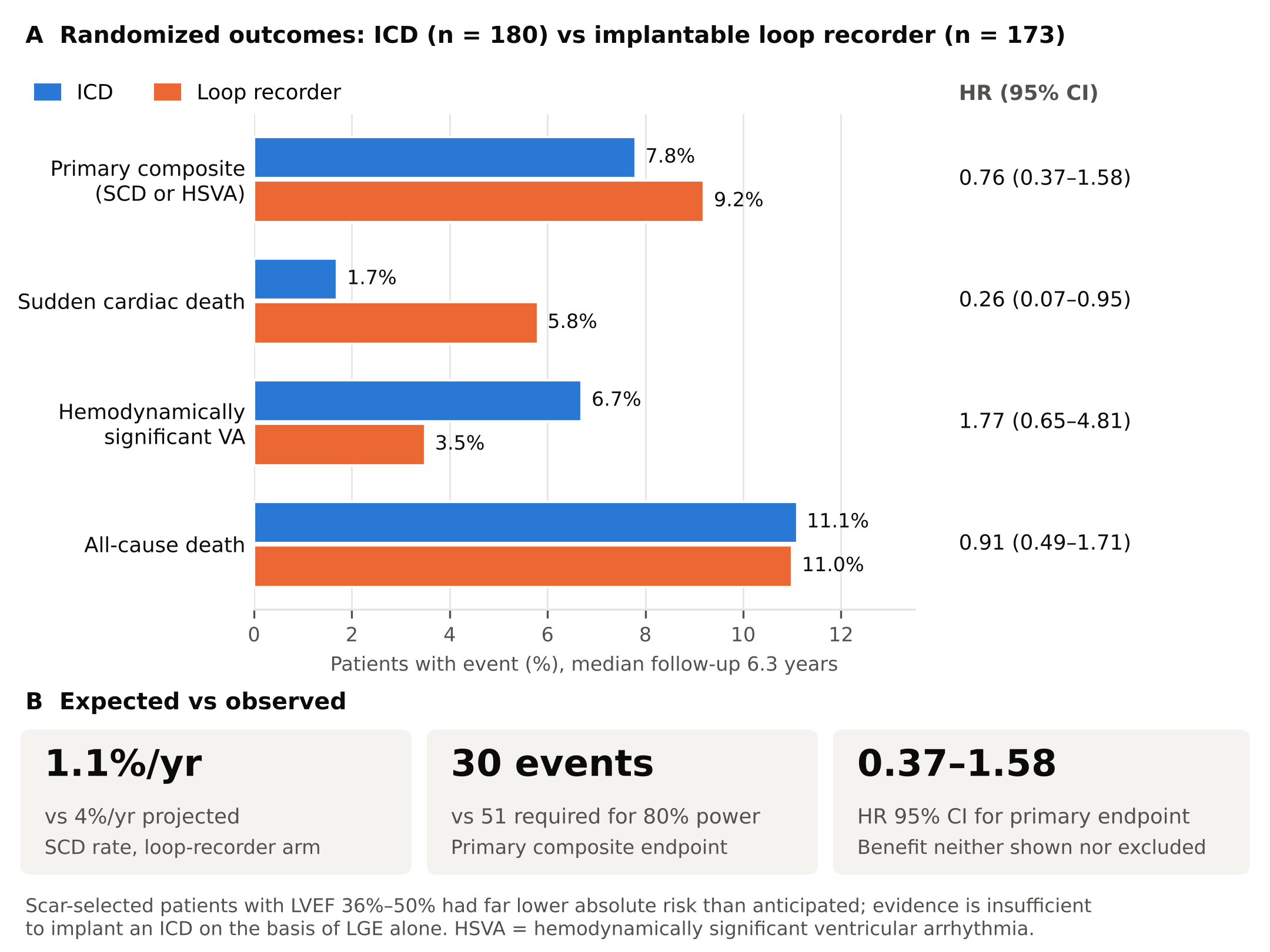
CMR GUIDE, designed over a decade ago11, is the first randomized test of whether scar detected by LGE should drive therapy. Eligibility required an LVEF of 36% to 50% plus LGE meeting etiology-specific criteria: in ischemic cardiomyopathy, scar involving more than 75% of wall thickness in at least 2 segments; in nonischemic cardiomyopathy, any LGE. Patients were randomized to a primary-prevention ICD or an implantable loop recorder (ILR). Median LGE extent was 18% to 19% of the left ventricular myocardium, a burden generally considered extensive. Among 353 patients followed for a median of 6.3 years, the composite of SCD or hemodynamically significant ventricular arrhythmia (HSVA) occurred in 14 of 180 patients assigned a defibrillator (7.8%) and 16 of 173 assigned an ILR (9.2%) [hazard ratio of 0.76 (95% confidence interval [CI], 0.37-1.58)]. All-cause mortality was similar at 11.1% versus 11.0%, and a prespecified hierarchical win ratio incorporating quality of life was 0.97 (95% CI, 0.74-1.27; P=.82)12. Only 30 of the 51 primary events required for 80% power to detect a hazard ratio of 0.45 accrued, and the primary-endpoint confidence interval accommodates a 63% relative reduction and a 58% relative increase. CMR GUIDE therefore failed to demonstrate benefit from an ICD in patients with mild or moderately reduced LVEF and scar, but it was underpowered to exclude a clinically important benefit.
Was the primary endpoint appropriate?
SCD occurred in 3 ICD patients (1.7%) versus 10 patients with ILR (5.8%) [hazard ratio 0.26 (95% CI, 0.07-0.95)]. On the other hand, HSVA, prespecified as a ventricular arrhythmia producing syncope or associated with a systolic blood pressure below 90 mm Hg, was numerically more frequent in the ICD group, 12 (6.7%) versus 6 (3.5%) in the ILR group [hazard ratio 1.77 (95% CI, 0.65-4.81)]. All 18 adjudicated HSVA events were associated with syncope12. The investigators postulate that an ICD that terminates ventricular fibrillation converts a death into a survived syncopal episode.
An ICD does not prevent ventricular arrhythmias; rather, by delivering timely therapy, it prevents SCD and hemodynamic instability. In this trial, ICD programming followed a MADIT-RIT-derived strategy of high-rate zones and delayed therapy13, an approach that in MADIT-RIT reduced inappropriate therapy and, with high-rate programming, all-cause mortality (hazard ratio 0.45). However, this approach allows arrhythmias to persist longer before therapy, which increases the likelihood of syncope and/or hypotension in those with an ICD despite preventing SCD. Thus, the trial adopted a strategy which potentially minimizes the impact of an ICD in preventing an adverse event. Put simply, the composite largely measured whether a malignant arrhythmia occurred, which an ICD does not prevent, rather than whether the patient survived it.
Scar-selected patients were not high risk
SCD in the ILR arm occurred at approximately 1.1% per year, against the 4% per year projected by the investigators12. Patients selected by the presence of scar, at an LVEF of 36% to 50%, on contemporary therapy, simply were not a high-risk population, and 70% of them had an LVEF of 40% or greater. This compounds, rather than contradicts, the endpoint problem: the composite diluted whatever benefit existed, and the low baseline risk capped how large that benefit could be. The investigators, however, argue that the control-arm SCD rate of 11 events per 100 patient-decades approximates the 4% to 6% five-year threshold at which hypertrophic cardiomyopathy guidelines prompt ICD consideration10. Those thresholds were derived in a younger population with lower competing nonarrhythmic mortality, where a device has decades to deliver benefit; in CMR GUIDE, roughly one-third of patients were 70 years or older12. Contemporary event rates may also be lower because of newer guideline-directed medical therapies and their broader adoption. More fundamentally, a risk threshold borrowed from another disease cannot license implantation in another population. Risk equivalence is not benefit equivalence, which is a major lesson of this trial.
Is the scar hypothesis refuted?
The investigators conclude that a possible reduction in SCD warrants further study12. However, in several populations a reduction in arrhythmic death has not translated into a survival benefit. DEFINITE reduced arrhythmic death in nonischemic cardiomyopathy without a significant reduction in all-cause mortality14; DINAMIT and IRIS showed that early after myocardial infarction, arrhythmic deaths averted by the device were offset by a rise in nonarrhythmic deaths15,16; DANISH produced similar results in a contemporary nonischemic cohort with LVEF ≤35%17. In CMR GUIDE, sudden death fell while total mortality was unchanged (11.1% vs 11.0%; hazard ratio 0.91 [95% CI, 0.49-1.71]), and cardiovascular mortality did not differ significantly (4.4% vs 7.5%; hazard ratio 0.53 [95% CI, 0.22-1.27])12. With 39 deaths in total, either the trial was too small to detect a true survival difference, or deaths the device averted were replaced by deaths from other causes. The study was not designed to distinguish between those possibilities. The study does highlight the potential benefit of ICD use in a younger population. Patients younger than 70 randomized to a defibrillator had fewer primary events (3.3% vs 10.0%; hazard ratio 0.28), with no benefit above that age (P=.01 for interaction)12. This was one of six prespecified subgroups, unadjusted for multiplicity, resting on 4 events versus 12. It echoes the age interaction in DANISH17, which makes it worth pursuing, but it remains a hypothesis.
Clinical interpretability
Several features of CMR GUIDE limit how readily its results translate into practice. In this trial, 72% of patients had an ischemic etiology12. CMR GUIDE is therefore, in practice, largely a trial of transmural infarct scar, and the 99 nonischemic patients constitute an underpowered stratum within this trial. The interaction between etiology of cardiomyopathy and ICD was not significant (hazard ratio 0.84 for ischemic, 0.59 for nonischemic), but the 8 events among nonischemic patients may be insufficient to test for an interaction. Although there has been enthusiasm regarding the significance of midwall fibrosis in nonischemic cardiomyopathy6,7, it may be premature to draw definitive conclusions regarding the impact of midwall fibrosis on SCD. With respect to guideline-directed medical therapy, only 8% to 9% of patients were treated with sodium-glucose cotransporter-2 inhibitors, because enrollment largely preceded their adoption in heart failure, and approximately 40% were on a mineralocorticoid receptor antagonist12. Since the control-arm SCD rate was already approximately 25% of the projected rate, maximal and contemporary therapy would most plausibly drive arrhythmic risk lower, thus strengthening the argument against ICD for primary prevention while making any future trial in this population even harder to power. The open-label design also permitted crossover: 11% of patients assigned to an ICD did not receive one, and 6% of those assigned to an ILR received a primary-prevention ICD, diluting the contrast between strategies12. Enrollment also fell short of the approximately 428 patients planned despite extended recruitment and follow-up, further limiting power. Lastly, the results of this trial may not be broadly applicable given 96% of participants were White and 82% male, and all 18 sites were in Australia, Germany, and the United Kingdom; whether the findings reproduce in North American practice is unknown.
Harm weighs more when benefit is small
Device-related adverse events occurred in 29 ICD patients versus 14 ILR patients, with 15 of 16 lead complications in the defibrillator group12. Heart failure hospitalization was numerically more frequent with a defibrillator (14.4% vs 12.1%; hazard ratio 1.13 [95% CI, 0.63-2.03]), a difference that was not statistically significant. Inappropriate therapy was infrequent, a genuine vindication of the delayed-therapy programming even as that same programming blunted the likelihood of demonstrating the benefit of an ICD in patients with scar and mild or moderately reduced LVEF. Quality of life was worse with a defibrillator by a mean of 5.8 points (95% CI, 2.4-9.3; P=.001) on the Minnesota Living with Heart Failure Questionnaire over follow-up, consistent with the well-documented psychological burden of living with an implanted defibrillator18.
When the untreated event rate is near 1% per year, patients are being asked to accept a small but statistically significant decrement in quality of life against a small and statistically unresolved reduction in sudden death. Because arrhythmic risk rises as LVEF falls, the same device-related burden buys greater absolute benefit at lower LVEF, so the risk-benefit balance favors an ICD at an LVEF ≤35% but has not been shown to do so at 36% to 50%.
What should change
CMR GUIDE does not provide sufficient evidence to change the guidelines for ICD implantation. On current evidence, scar on CMR alone should not be regarded as an indication for a primary-prevention defibrillator at an LVEF of 36% to 50%. The only randomized test of that strategy found no benefit on its primary endpoint, no mortality signal, more complications, and worse quality of life. Equally, the trial does not show that ICDs are futile in this range; it was underpowered, and its confidence intervals remain compatible with meaningful benefit (Figure 1; Table 1). Because essentially every randomized patient had scar, the trial could not test whether LGE separates high-risk from low-risk patients. Rather, a prespecified scar phenotype, applied at an LVEF of 36% to 50% in a largely ischemic and older population, identified patients whose absolute arrhythmic risk was substantially lower than anticipated. Scar marks arrhythmic substrate, but whether a device delivers net benefit depends on absolute risk, competing mortality, and age. More detailed phenotyping can therefore narrow ICD indications as readily as it might expand them.

| CMR GUIDE supports | CMR GUIDE does not establish |
|---|---|
| Scar-selected patients with LVEF 36%-50% had substantially lower event rates than anticipated (SCD 1.1%/year in the ILR arm vs 4%/year projected) | That ICDs provide no benefit to any patient with LVEF 36%-50% |
| The randomized primary endpoint was neutral (HR 0.76; 95% CI, 0.37-1.58) | That the lower SCD rate with an ICD (HR 0.26) is a definitive treatment effect |
| SCD and HSVA moved in opposite directions, consistent with the hypothesis that an ICD converts sudden death into syncope | That LGE lacks prognostic value (all randomized patients had scar) |
| ICD implantation carried more device-related complications and worse quality of life | That scar alone should guide ICD implantation |
| Nonischemic and younger subgroups remain uncertain and hypothesis-generating | That patients younger than 70 years have an established indication |
CI, confidence interval; CMR, cardiovascular magnetic resonance; HR, hazard ratio; HSVA, hemodynamically significant ventricular arrhythmia; ICD, implantable cardioverter-defibrillator; ILR, implantable loop recorder; LGE, late gadolinium enhancement; LVEF, left ventricular ejection fraction; SCD, sudden cardiac death.
The design of CMR GUIDE also offers concrete lessons for future trials. First, endpoints must be ascertained identically in both arms. Appropriate ICD therapy is not equivalent to an averted death, because many treated arrhythmias would have self-terminated, and it is observable only in patients with a device; counting it as a success would reintroduce the bias that inflated early estimates of ICD benefit. All-cause mortality, or a hierarchical endpoint led by death and resuscitated cardiac arrest, is preferable. Second, enrollment should focus on patients in whom a device has time to deliver benefit, namely younger patients without a substantial competing risk of noncardiac death, so that the age interaction observed here can be tested prospectively. CMR GUIDE tested a worthy hypothesis with an endpoint that was suboptimally designed to demonstrate a clinically significant benefit, in a population of lower-than-anticipated risk.