
Pulmonary hypertension is a common and consequential final pathway of cardiovascular and pulmonary disease, affecting an estimated 31.5 million people worldwide. More than half of that burden, roughly 16 million people, is attributable to pulmonary hypertension associated with left heart disease (PH-LHD), or World Health Organization group 2 pulmonary hypertension.1 Despite its prevalence and strong association with heart failure hospitalization, right ventricular failure, and death, PH-LHD has no approved therapy directed at the pulmonary circulation.2,3 Treatment is limited to the underlying heart failure or valvular disease, while attempts to repurpose pulmonary arterial hypertension drugs have been neutral or harmful.4-6 This therapeutic gap invites a device-based analogy. Calcific aortic valve disease carries a comparable global burden of approximately 12.6 million cases and likewise has no medical therapy capable of reversing the fixed disease process, yet surgical and then transcatheter aortic valve replacement transformed its prognosis.7 Against that precedent, the PADN-HF-PH trial asks whether pulmonary artery denervation (PADN) might offer a procedural solution where pharmacotherapy has reached its limits.8
PH-LHD is not a single disease. Elevated left-sided filling pressure initially produces passive, postcapillary pulmonary hypertension; in some patients, sustained exposure is accompanied by pulmonary vasoconstriction, remodeling, increased pulmonary vascular resistance (PVR), right ventricular-pulmonary arterial uncoupling, and right ventricular failure. This distinction separates isolated postcapillary pulmonary hypertension (IpcPH; PVR ≤2 Wood units) from combined precapillary and postcapillary pulmonary hypertension (CpcPH; PVR >2 Wood units), the latter generally carrying a worse prognosis.2,9
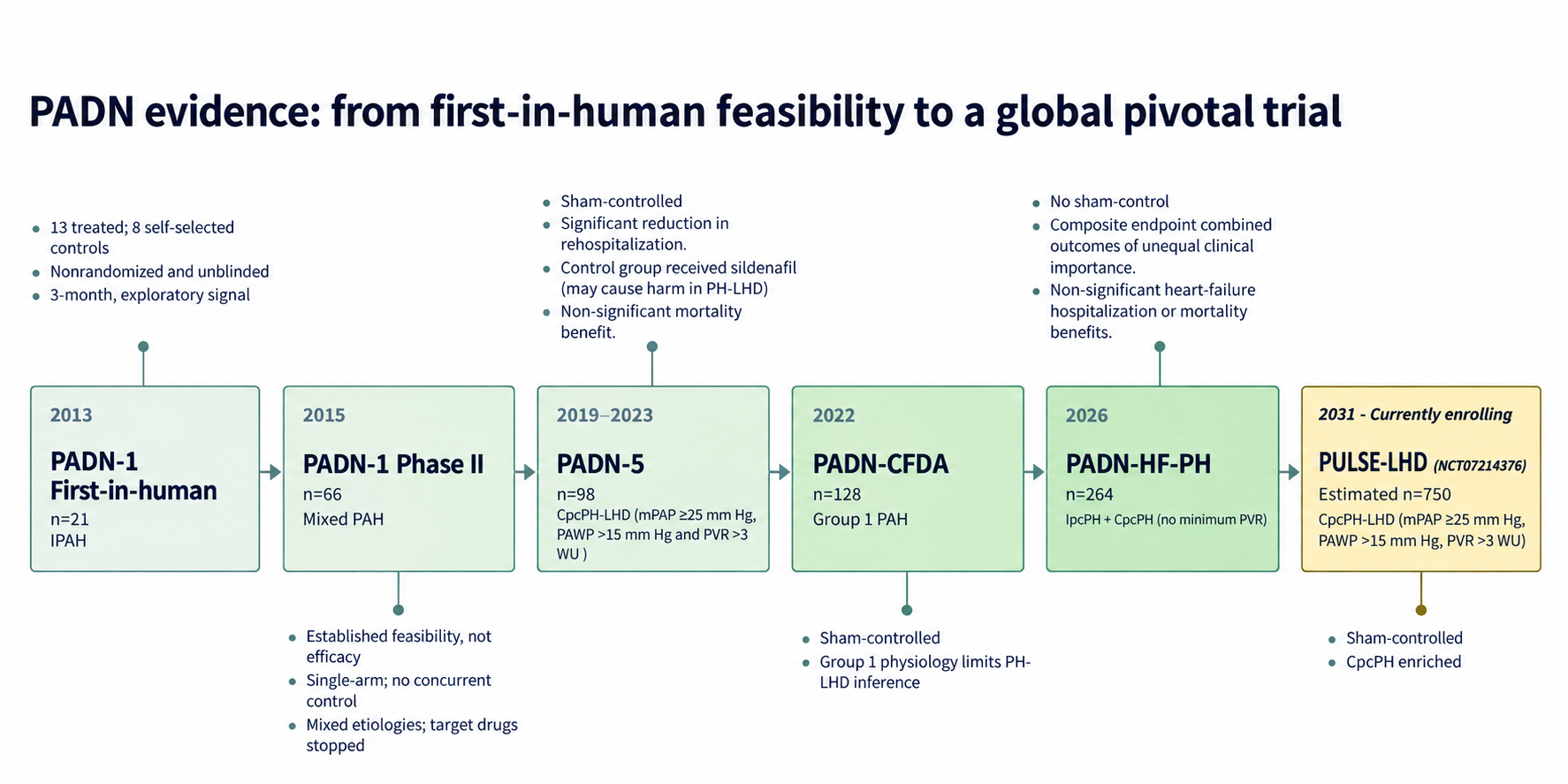
Sympathetic activation is integral to both heart failure and pulmonary vascular dysfunction. PADN uses radiofrequency ablation near the distal main pulmonary artery and its bifurcation to interrupt sympathetic fibers, with the aim of lowering pulmonary vascular tone and afterload rather than adding another vasodilator.8 The PADN program has evolved over more than a decade (Figure 1). The first-in-human and phase II studies established feasibility but were small, nonrandomized, and uncontrolled.10,11 PADN-5 produced striking functional and hemodynamic signals in CpcPH, but interpretation was complicated by a control regimen that included sildenafil, a therapy that is unproven and potentially harmful in PH-LHD.4,12,13 PADN-CFDA provided sham-controlled evidence in group 1 pulmonary arterial hypertension, a physiology that cannot be assumed to translate to group 2 disease.14 An early feasibility study of intravascular ultrasound denervation is a reminder that PADN is a family of procedures rather than a single standardized technique.15 PADN-HF-PH was therefore the program’s most consequential test: a larger randomized evaluation on a background of contemporary heart failure therapy.16

What PADN-HF-PH Adds
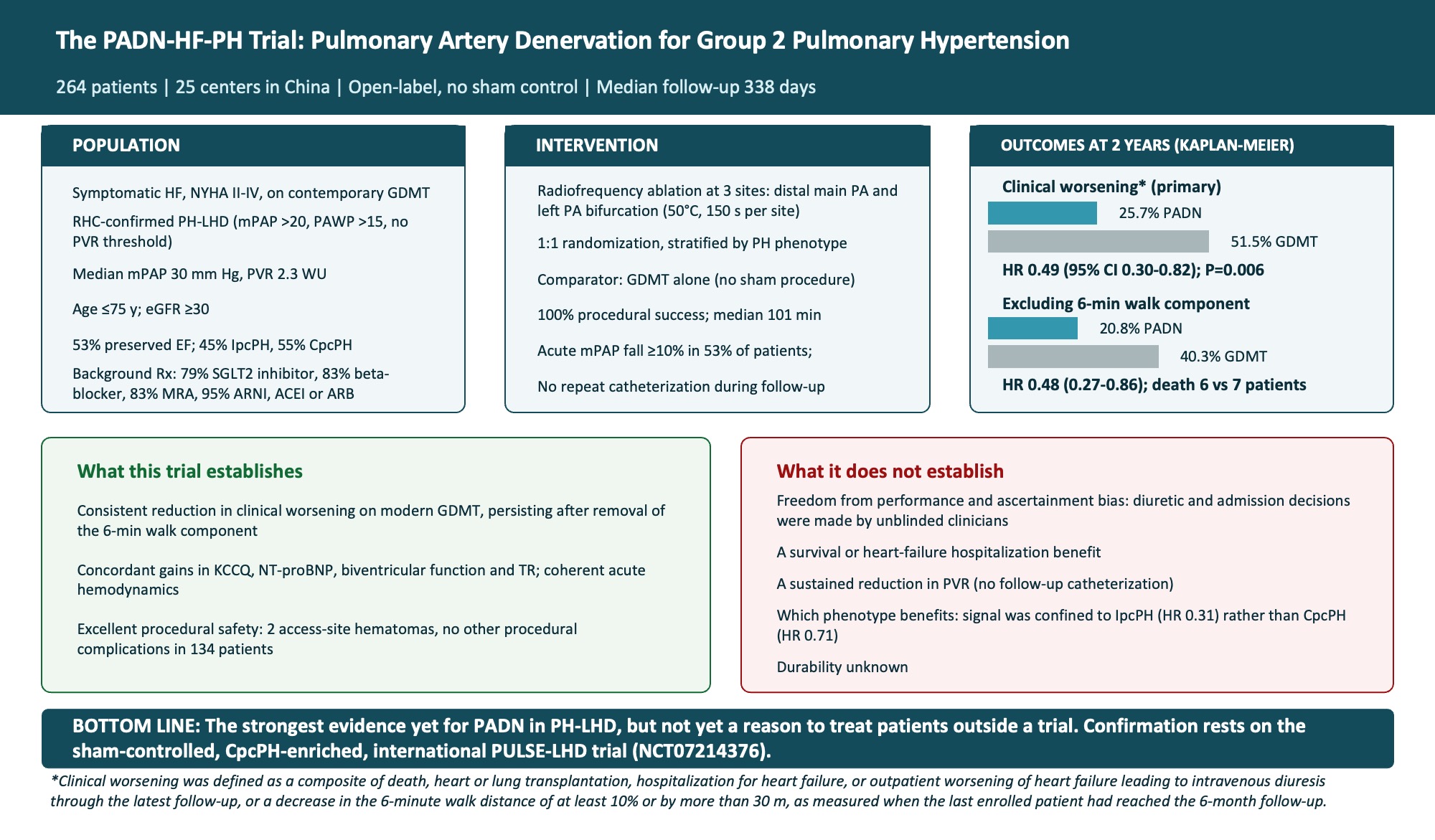
Zhang and colleagues enrolled 264 symptomatic patients with right heart catheterization-confirmed PH-LHD at 25 centers in China, randomly assigning 134 to PADN plus guideline-directed medical therapy (GDMT) and 130 to GDMT alone.8 Baseline characteristics included 53% with preserved ejection fraction, 44.7% with IpcPH, and 55.3% with CpcPH. Median mean pulmonary artery pressure was 30 mm Hg, wedge pressure 19 mm Hg, and PVR 2.3 Wood units. Background therapy was contemporary: approximately 79% received a sodium-glucose cotransporter 2 (SGLT2) inhibitor, 83% a beta-blocker, 83% a mineralocorticoid receptor antagonist, and 95% renin-angiotensin system or neprilysin inhibition. PADN was completed in all assigned patients, with a median procedure time of 101 minutes and no procedural complications other than two access-site hematomas. However, fluoroscopy time and radiation dose, as well as operator specialty, prior PADN experience, and procedural case volume, were not reported, limiting assessment of procedural efficiency and reproducibility.
At a median follow-up of 338 days, clinical worsening occurred in 25 PADN-treated patients and 42 controls. The Kaplan-Meier-estimated 2-year incidence was 25.7% versus 51.5% (hazard ratio [HR], 0.49; 95% confidence interval [CI], 0.30-0.82; P=0.006). Recurrent events were also reduced (annualized rate, 36.3 vs. 56.3 per 100 patient-years; HR, 0.59; 95% CI, 0.39-0.89). Importantly, the finding was not driven solely by the 6-minute walk distance (6MWD), which had been the chief concern before publication: after excluding 6MWD decline, clinical worsening remained lower with PADN (20.8% vs. 40.3%; HR, 0.48; 95% CI, 0.27-0.86). Heart failure hospitalization favored PADN numerically (24.8% vs. 33.0%; HR, 0.56; 95% CI, 0.30-1.04), as did outpatient worsening requiring intravenous therapy (16.5% vs. 32.2%; HR, 0.58; 95% CI, 0.31-1.11). Death was similar between arms (6 vs. 7 patients).
These results are difficult to dismiss as a simple exercise-training or expectancy effect. The treatment signal persisted in sensitivity analyses and even when the most subjective component was removed. Concordant improvements in 6MWD, Kansas City Cardiomyopathy Questionnaire (KCCQ) score, natriuretic peptide levels, biventricular function, estimated right-sided pressures, and tricuspid regurgitation support biologic activity. Acute reductions in pulmonary pressure, PVR, and wedge pressure, along with increased cardiac output, provide mechanistic coherence. Consistency across clinical, functional, biomarker, and echocardiographic domains is the trial’s greatest strength.
A Strong Signal With Important Caveats
The greatest limitation of PADN-HF-PH was the open-label design without including a sham procedure (Table 1). Patients, treating clinicians, research personnel, and outcome assessors knew the treatment allocation. Although events were independently adjudicated and imaging and biomarker analyses were blinded, decisions to admit a patient or escalate diuretics are precisely the outcomes most sensitive to knowledge of treatment. The reduced 6MWD decline seen in the treatment group is reassuring, but that endpoint was secondary, unadjusted for multiplicity, and neither heart failure hospitalization nor mortality reached significance on its own. The trial establishes a strong signal of reduced clinical worsening; it does not establish a survival or hospitalization benefit.
| Domain | What PADN-HF-PH showed | What remains unresolved |
|---|---|---|
| Blinding | Open-label; events adjudicated and echocardiographic, hemodynamic and biomarker data analyzed blinded. | Patients, treating physicians and outcome assessors were unblinded, and admission and diuretic decisions are expectation-sensitive. A sham arm is required. |
| Primary endpoint | Clinical worsening 25.7% vs 51.5% (HR 0.49; 95% CI 0.30-0.82); effect persisted after removal of the 6-minute walk component (HR 0.48; 95% CI 0.27-0.86). | The composite combined outcomes of unequal importance; the analysis excluding walk distance was secondary and unadjusted for multiplicity. |
| Death and hospitalization | Death 6 vs 7 patients; heart failure hospitalization HR 0.56 (95% CI 0.30-1.04). | The trial was not powered for either. Confirmation requires adequate power for adjudicated cardiovascular death and heart failure hospitalization. |
| Hemodynamics | Acute falls in mean pulmonary artery pressure, pulmonary vascular resistance and wedge pressure with increased cardiac output at 10 minutes. | No repeat right heart catheterization during follow-up, so sustained reduction in pulmonary vascular resistance and improved right ventricular-pulmonary arterial coupling remain undemonstrated. |
| Phenotype | No minimum pulmonary vascular resistance for entry; 44.7% isolated postcapillary and 55.3% combined precapillary and postcapillary disease. | The confidence interval excluded unity only in isolated postcapillary disease (HR 0.31) and not in the combined phenotype (HR 0.71). Enrichment and analysis across continuous pulmonary vascular resistance are needed. |
| Generalizability | 264 patients at 25 Chinese centers, 75 years of age or younger, with estimated glomerular filtration rate above 30 mL/min/1.73 m2 and cardiac index above 1.5 L/min/m2. | Older, frailer patients with chronic kidney disease, device therapy and multimorbidity, who dominate Western practice, were underrepresented or excluded. |
| Durability and late safety | Procedural success 100%; two access-site hematomas and no other procedural complications; median follow-up 338 days. | Reinnervation, late pulmonary artery stenosis, aneurysm or thrombosis, and the feasibility and safety of repeat denervation are unknown. |
| Technique | Radiofrequency ablation at three sites, 150 seconds each under temperature control at 50°C. | Operator learning curve is undefined and the energy modality is not standardized across programs, differences in radiofrequency vs intravascular ultrasound. |
CI = confidence interval; CpcPH = combined precapillary and postcapillary pulmonary hypertension; HR = hazard ratio; IpcPH = isolated postcapillary pulmonary hypertension; PADN = pulmonary artery denervation.
Mechanistic interpretation is also incomplete. The investigators documented acute hemodynamic improvement, but right heart catheterization was not repeated during follow-up, so a sustained reduction in PVR, the most direct evidence that PADN modifies pulmonary vascular disease, cannot be demonstrated. This limitation is particularly important given the substantial clinical and hemodynamic heterogeneity of the study population, which included patients with heart failure with reduced, mildly reduced, and preserved ejection fraction, as well as potentially different contributions from elevated left-sided filling pressures, pulmonary vascular remodeling, and right ventricular dysfunction. Patients were eligible without a minimum PVR, and nearly half had IpcPH, in which elevated pressure may largely reflect passive transmission from the left atrium. In the prespecified subgroup analysis, the confidence interval excluded unity only among patients with IpcPH (HR, 0.31; 95% CI, 0.12-0.79), whereas the effect was not significant in CpcPH (HR, 0.71; 95% CI, 0.39-1.28). Point estimates favored PADN in both groups, and neither subgroup analysis was powered or adjusted for multiplicity, so this is not evidence of true heterogeneity. It is, however, the opposite of what the pulmonary vascular hypothesis predicts. A small proof-of-principle study reporting improved left ventricular diastolic function after PADN in IpcPH offers one explanation, but if the dominant mechanism is left-sided rather than pulmonary vascular, then what PADN is and whom it should treat both change.17 The apparently larger effects in women and in patients with an ejection fraction above 40% should likewise be treated as hypothesis-generating. Future trials should prospectively define clinical and hemodynamic phenotypes, evaluate treatment effects across continuous measures such as PVR and ejection fraction, and determine whether PADN benefits the broader PH-LHD population or a more narrowly defined responder phenotype.
Generalizability warrants equal caution. All patients were enrolled in China, were 75 years of age or younger, and had relatively preserved renal function and systemic perfusion. The advanced age, frailty, kidney disease, device therapy, and multimorbidity that characterize Western PH-LHD populations were underrepresented or excluded. Operator learning, reproducibility, and durability beyond the current follow-up remain unresolved, and the current data cannot tell us whether reinnervation, progression of left heart disease, or recurrent pulmonary vascular remodeling will attenuate benefit, whether repeat denervation would be feasible after prior radiofrequency injury, or whether late pulmonary artery stenosis, aneurysmal change, or thrombosis will emerge outside the early procedural window. A procedure of roughly 100 minutes must ultimately justify its resource use not only against GDMT alone but also against structured heart failure care and optimized treatment of concomitant valve disease, atrial fibrillation, obesity, and sleep-disordered breathing.
Why the Sham Arm Is Not a Formality
Interventional cardiology has learned this lesson twice. ORBITA showed that an unblinded procedural benefit, taken as self-evident, could shrink substantially once patients were blinded, and SYMPLICITY HTN-3 halted the first wave of renal denervation after a sham-controlled trial failed to reproduce open-label results.18,19 The instructive part is what followed: renal denervation was not abandoned but redesigned, and rigorously blinded trials such as SPYRAL HTN-OFF MED Pivotal ultimately demonstrated a real, if more modest, treatment effect.20 A sham arm is not an obstacle placed in front of a promising therapy; it is the mechanism by which a promising therapy earns durable adoption. Given that PADN-HF-PH’s benefit rests substantially on unblinded, expectation-sensitive endpoints such as outpatient diuretic escalation, the field should want that test rather than resist it.
From Signal to Standard
Our position is therefore straightforward. PADN-HF-PH is a well-conducted trial that provides the strongest signal yet for a pulmonary vascular intervention in group 2 pulmonary hypertension, and it deserves to be treated as such. However, it should not change practice. Outside a clinical trial, PADN should not be offered to patients with PH-LHD based on these data, and reimbursement or guideline endorsement would be premature.
The ongoing international PULSE-LHD trial (NCT07214376) is therefore not redundant; it is the necessary next step. Its sham-controlled design and enrichment for CpcPH address the two central uncertainties remaining after PADN-HF-PH: expectation-sensitive bias and biological dilution from predominantly passive pulmonary hypertension. A confirmatory program should prioritize adequately powered, adjudicated cardiovascular death and heart failure hospitalization; serial invasive hemodynamics with assessment of right ventricular-pulmonary arterial coupling; a prespecified treatment-effect analysis across continuous PVR rather than a dichotomized phenotype; a standardized ablation technique with reporting of operator experience; and long-term pulmonary artery imaging for late stenosis, aneurysm, thrombosis, or loss of efficacy.
PADN-HF-PH moves pulmonary artery denervation beyond feasibility and into the category of therapies that plausibly could alter the course of PH-LHD. The magnitude of benefit, the contemporary background therapy, the clean procedural safety profile, and the concordance of objective findings are all real. So is the fact that a common, heterogeneous syndrome treated with an irreversible ablative procedure demands a higher evidentiary threshold than an unblinded composite can provide. The right response to this trial is neither adoption nor dismissal, but referral of eligible patients to rigorously designed, sham-controlled trials.