Cardiac myosin inhibitors (CMIs) have transformed the therapeutic landscape of obstructive hypertrophic cardiomyopathy (HCM). By reducing excessive actin–myosin cross-bridge formation, they mitigate left ventricular (LV) hypercontractility, decrease LV outflow tract obstruction and improve symptoms and exercise capacity.1,2 Extending this approach to nonobstructive HCM (nHCM) is less straightforward: in the absence of a dominant, reversible hemodynamic cause, symptoms reflect diastolic dysfunction, impaired stroke-volume reserve, and microvascular ischemia, on a background of myocardial fibrosis and atrial disease.3,4 That nHCM is a harder nut to crack was illustrated by ODYSSEY-HCM, a large international randomized trial of mavacamten in which neither health status nor exercise capacity improved significantly versus placebo.5
Conversely, the ACACIA-HCM trial has recently provided randomized evidence that cardiac myosin inhibition can improve health status and exercise capacity in selected patients with nHCM.6 Yet the apparent contrast between a “negative” ODYSSEY-HCM and a “positive” ACACIA-HCM is driven more by statistical significance than by major differences in treatment effect.7 Together, these trials raise a broader question: how should the clinical benefit of myosin inhibition be interpreted in a heterogeneous syndrome such as nHCM (Figure 1)?

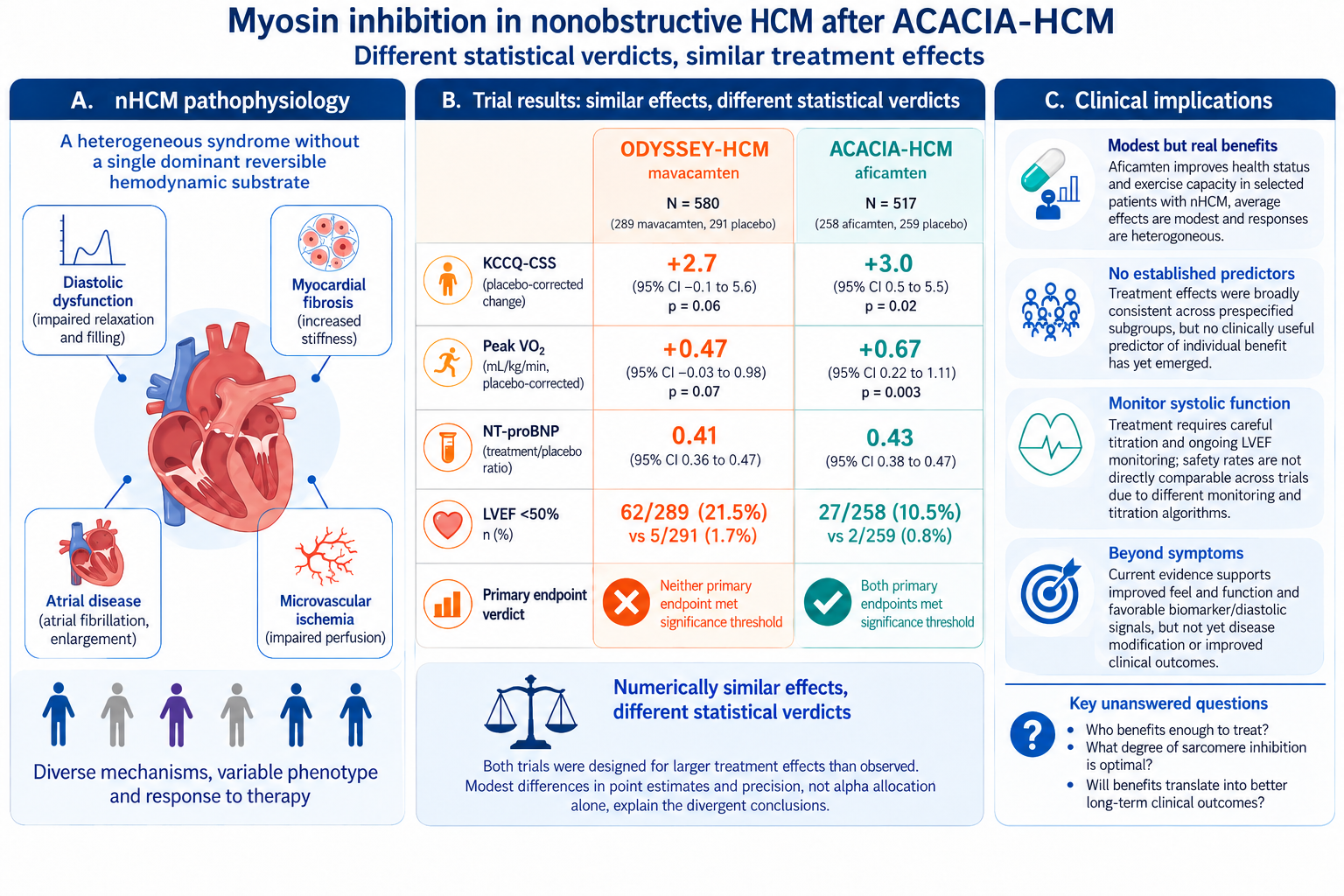
From biological activity to clinical efficacy
Before phase 3 testing, both mavacamten and aficamten had already shown evidence of biological activity in nHCM. In MAVERICK-HCM, mavacamten substantially reduced N-terminal pro-B-type natriuretic peptide (NT-proBNP) and troponin despite limited evidence of clinical improvement.8 Aficamten subsequently improved biomarkers and symptoms in the nonobstructive cohort of REDWOOD-HCM, although the open-label design precluded definitive conclusions regarding efficacy.9
ODYSSEY-HCM randomized 580 patients with symptomatic nHCM. Mavacamten produced placebo-corrected changes of +2.7 points in the Kansas City Cardiomyopathy Questionnaire Clinical Summary Score (KCCQ-CSS; 95% confidence interval [CI], −0.1 to 5.6; p=0.06) and +0.47 mL/kg/min in peak oxygen uptake (peak VO2; 95% CI, −0.03 to 0.98; p=0.07), with neither endpoint meeting its prespecified significance threshold.5 NT-proBNP nevertheless fell by 58% from baseline in the mavacamten arm (within-arm geometric mean ratio, 0.42; 95% CI, 0.37 to 0.47; the mavacamten-to-placebo ratio was 0.41; 95% CI, 0.36 to 0.47), with a parallel 51% reduction in high-sensitivity troponin I.10
ACACIA-HCM randomized 517 patients. At week 36, placebo-corrected changes were +3.0 points in KCCQ-CSS (95% CI, 0.5 to 5.5; p=0.02) and +0.67 mL/kg/min in peak VO2 (95% CI, 0.22 to 1.11; p=0.003). New York Heart Association (NYHA) class improved in 41.9% versus 27.8% of patients, the composite exercise-performance z score improved, and the NT-proBNP ratio versus placebo was 0.43. The prespecified hierarchical multiplicity-testing procedure successfully progressed through these efficacy endpoints to left atrial volume index (LAVI), for which the treatment effect did not reach statistical significance (−1.30 mL/m²; 95% CI, −2.64 to 0.04; p=0.06). Because rejection of the LAVI hypothesis was required before formal testing of the cardiovascular-event endpoint, that endpoint was not formally tested.6
Descriptively, a first cardiovascular event occurred in 22 of 258 patients (8.5%) receiving aficamten and 20 of 259 (7.7%) receiving placebo; the model-estimated time to first cardiovascular event was 68.2 versus 68.8 weeks (between-group difference, −0.6 weeks; 95% CI, −3.3 to 2.2; nominal p=0.678). These data quantify the uncertainty but should not be interpreted as confirmatory evidence of either benefit or no benefit.6 Among patients with longer follow-up, the between-group difference in KCCQ-CSS remained approximately 5–7 points through week 72 but narrowed to 0.5 points four weeks after treatment withdrawal.6 This within-trial de-challenge pattern strengthens the inference that the observed health-status benefit was treatment related.
The responder analysis provides additional context for these mean treatment effects. A symptom response occurred in 71% of patients receiving aficamten versus 53% receiving placebo, while 53% versus 14% met at least three of five prespecified response criteria.7 Importantly, a 3-point between-group mean KCCQ-CSS effect should not be judged against the ≥5-point threshold commonly used to define clinically important change within an individual patient, because these are different estimands. In a patient-level meta-analysis of 11 randomized trials, a 2.5-point mean KCCQ difference corresponded to an approximately 6% absolute increase in patients achieving a ≥5-point improvement, illustrating why mean effects and responder distributions provide complementary information.11 The ACACIA-HCM findings therefore support a meaningful shift in the distribution of individual responses without implying that benefit is large or consistent in every patient. These findings remain supportive rather than confirmatory, however, because the analysis was not adjusted for multiple comparisons and several response thresholds were extrapolated from other settings rather than validated specifically in nHCM.7
Similar trials, but not identical populations
ACACIA-HCM and ODYSSEY-HCM enrolled broadly similar symptomatic populations but used different enrichment strategies (Table 1). ACACIA-HCM relied primarily on higher NT-proBNP thresholds, whereas ODYSSEY-HCM used lower natriuretic-peptide thresholds combined with elevated troponin or echocardiographic evidence of diastolic dysfunction.5,6 Nevertheless, baseline disease burden was remarkably similar: median NT-proBNP was 893 and 918 ng/L and mean peak VO2 18.0 and 18.2 mL/kg/min in ACACIA-HCM and ODYSSEY-HCM, respectively.5,6 The different entry criteria therefore do not support substantially greater physiological disease enrichment in either trial, but the enrolled populations were not identical.
| ODYSSEY-HCM | ACACIA-HCM | |
|---|---|---|
| Myosin inhibitor | Mavacamten | Aficamten |
| Randomized population | 580 randomized (289 mavacamten, 291 placebo) | 517 randomized (258 aficamten, 259 placebo); 516 treated |
| Primary assessment | 48 weeks | 36 weeks |
| Core phenotype | Symptomatic nHCM; NYHA II-III; LVEF ≥60%; KCCQ-CSS ≤85; maximal CPET (RER ≥1.0); predicted peak VO2 threshold not required; provocative maneuvers and stress echocardiography required to exclude latent LVOT obstruction | Symptomatic nHCM; NYHA II-III; LVEF ≥60%; KCCQ-CSS ≤85; maximal CPET (RER ≥1.0); predicted peak VO2 ≤90%; exercise echocardiography not required; intracavitary obstruction permitted |
| Biomarker / echocardiographic enrichment | NT-proBNP ≥200 ng/L; ≥500 ng/L with AF/AFL. If African descent or BMI ≥30 kg/m²: ≥160 or ≥400 ng/L with AF/AFL; BNP alternatives permitted. Additionally required troponin >99th percentile OR E/e′ >14 OR LAVI >34 mL/m². | NT-proBNP ≥300 ng/L; ≥900 ng/L with AF/AFL. Black participants: ≥225 or ≥675 ng/L with AF/AFL. No additional troponin/diastolic-dysfunction criterion. |
| Baseline disease burden | Median NT-proBNP 917.5 ng/L; KCCQ-CSS 56.9; peak VO2 18.2 mL/kg/min | Median NT-proBNP 893 ng/L; KCCQ-CSS 65.7; peak VO2 18.0 mL/kg/min |
| Atrial fibrillation/flutter | 34.6% | 35.9% |
| Sample-size / power assumptions | Original target 420; assumed effects: KCCQ-CSS 5 points (SD 14) and peak VO2 1.3 mL/kg/min (SD 3.1); ≥95% and ≥98% power, respectively | Around 500; assumed effects: KCCQ-CSS 5 points (SD 15) and peak VO2 1.0 mL/kg/min (SD 3.0); ≥90% power for each endpoint, allowing 10% missing data |
| Multiplicity / alpha | Graphical testing; initial α=0.04 for KCCQ-CSS and α=0.01 for peak VO2; trial considered positive if at least one primary endpoint met its multiplicity-adjusted threshold | Initial α=0.025 for each primary endpoint within a graphical multiplicity procedure; trial success if either primary null hypothesis was rejected |
| KCCQ-CSS: placebo-corrected effect | +2.7 points (95% CI, −0.1 to 5.6); p=0.06 | +3.0 points (95% CI, 0.5 to 5.5); p=0.02 |
| Peak VO2: placebo-corrected effect | +0.47 mL/kg/min (95% CI, −0.03 to 0.98); p=0.07 | +0.67 mL/kg/min (95% CI, 0.22 to 1.11); p=0.003 |
| NT-proBNP effect | Week 48 mavacamten/placebo NT-proBNP ratio 0.41 (95% CI, 0.36 to 0.47); within-mavacamten geometric mean ratio 0.42 (95% CI, 0.37 to 0.47); not reached for formal confirmatory testing in the primary multiplicity sequence | Week 36 aficamten/placebo ratio 0.43 (95% CI, 0.38 to 0.47); p<0.001 |
| Observed effect vs design assumption | KCCQ-CSS effect ≈54% of assumed effect; peak VO2 ≈36% | KCCQ-CSS effect ≈60% of assumed effect; peak VO2 ≈67% |
| Placebo-group KCCQ-CSS improvement | +10.4 points | +8.4 points |
| LVEF reduction | LVEF <50%: 62/289 (21.5%) vs 5/291 (1.7%); LVEF ≤30%: 2.4% vs 0 | Core-laboratory LVEF <50%: 27/258 (10.5%) vs 2/259 (0.8%); LVEF <40%: 5.4% vs 0.4%; LVEF <30%: 1.2% vs 0 |
| Dosing strategy | LVEF-guided titration based on blinded core-laboratory echocardiography; starting dose 5 mg, maximum 15 mg | LVEF-guided escalation toward maximum tolerated dose (5-20 mg); escalation at weeks 2, 4, and 6 if LVEF ≥60%; ≈58% received 20 mg after dose adjustment; frequent serial echocardiography |
| Protocol action for low LVEF | Core-laboratory LVEF <50% prompted treatment interruption; LVEF ≤30% was a permanent-discontinuation criterion. Any trial-regimen interruption: 25.7% vs 7.6%. | Site-read LVEF <50% prompted dose reduction; site-read LVEF <40% prompted temporary interruption. Seven aficamten-treated patients (2.7%) met the site-read <40% interruption threshold. |
| Patient-level responder analysis | No directly comparable multidomain responder analysis reported | Prespecified supportive analysis: ≥3/5 domains 53% vs 14% (p<0.001); symptoms 71% vs 53%; peak VO2 ≥0.5 mL/kg/min 45% vs 37% (p=0.1); no multiplicity adjustment |
| Outcome hierarchy | Neither primary endpoint crossed its prespecified multiplicity-adjusted threshold; confirmatory testing did not progress through the secondary hierarchy | LAVI did not meet its threshold (p=0.06); cardiovascular-event endpoint therefore not formally tested. Descriptively: 22/258 (8.5%) vs 20/259 (7.7%) events; model-estimated time to first event 68.2 vs 68.8 weeks, difference −0.6 weeks (95% CI, −3.3 to 2.2) |
| Principal interpretation | Neither primary endpoint met its prespecified threshold despite directionally favorable clinical and marked biomarker signals; systolic dysfunction and treatment interruption were frequent | Both primary endpoints positive, with modest average effects; responder analysis shows heterogeneous benefit. Echocardiographic changes support reversible diastolic target engagement, with a need for structured LVEF monitoring |
AF/AFL, atrial fibrillation/flutter; BMI, body mass index; BNP, B-type natriuretic peptide; CI, confidence interval; CPET, cardiopulmonary exercise testing; E/e′, ratio of early mitral inflow velocity to early diastolic mitral annular velocity; KCCQ-CSS, Kansas City Cardiomyopathy Questionnaire Clinical Summary Score; LAVI, left atrial volume index; LVEF, left ventricular ejection fraction; LVOT, left ventricular outflow tract; nHCM, nonobstructive hypertrophic cardiomyopathy; NT-proBNP, N-terminal pro-B-type natriuretic peptide; NYHA, New York Heart Association; peak VO2, peak oxygen uptake; RER, respiratory exchange ratio; SD, standard deviation. Safety rates are shown descriptively and are not directly comparable across trials because monitoring, titration, LVEF action thresholds, and treatment schedules differed.
One important asymmetry between the trials deserves emphasis. ODYSSEY-HCM required provocative maneuvers and stress echocardiography to exclude latent LV outflow tract obstruction,5 whereas ACACIA-HCM did not mandate exercise echocardiography, and the investigators acknowledged that some patients with exercise-induced obstruction may therefore have been enrolled.6 The low mean post-Valsalva gradient (<12 mm Hg) argues against widespread contamination by an obstructive phenotype but cannot exclude a minority with exercise-provocable gradients; moreover, intracavitary obstruction was permitted in ACACIA-HCM.6 Even limited inclusion of patients with latent obstruction could have favored aficamten, because relief of dynamic obstruction represents the setting in which CMIs have their most established efficacy. Reassuringly, treatment effects on both primary endpoints were broadly consistent across prespecified ACACIA-HCM subgroups, including the presence or absence of intracavitary obstruction, but subgroup consistency does not identify a clinically useful predictor of individual response.6 Despite substantial trial enrichment, “nonobstructive HCM” therefore remained a clinically heterogeneous construct.
Different statistical verdicts, similar treatment effects
To fully appreciate the potential impact of CMIs on nHCM, it is important to retain a global perspective on the two phase 3 trials. ODYSSEY-HCM remains formally negative because neither primary null hypothesis was rejected, yet its confidence intervals encompass treatment effects close to those observed in ACACIA-HCM. Conversely, the achievement of statistical significance in ACACIA-HCM should not be interpreted as evidence of a materially larger underlying treatment effect. The contrast between the trials is therefore sharper at the level of statistical inference than at the level of observed efficacy.
Both trials were designed around treatment effects substantially larger than those ultimately observed. ACACIA-HCM was powered assuming treatment effects of 5 points in KCCQ-CSS and 1.0 mL/kg/min in peak VO2; approximately 500 patients provided ≥90% power for each endpoint, with an initial two-sided alpha of 0.025 allocated to each.6 ODYSSEY-HCM assumed the same 5-point KCCQ-CSS effect but a larger 1.3-mL/kg/min improvement in peak VO2, allocating alpha=0.04 and alpha=0.01 to the two co-primary endpoints, respectively, with estimated power ≥95% and ≥98%.5,12 Different alpha allocations, however, do not by themselves explain the divergent verdicts: with p=0.06 for KCCQ-CSS and p=0.07 for peak VO2, ODYSSEY-HCM would also have remained negative under ACACIA-HCM’s initial alpha of 0.025 for either endpoint. ACACIA-HCM combined slightly larger observed effects with somewhat greater precision: the 95% CI width was 5.0 versus 5.7 points for KCCQ-CSS and 0.89 versus 1.01 mL/kg/min for peak VO2, despite randomizing fewer patients.5,6 ODYSSEY-HCM enrolled 580 patients, 38% more than its original target of 420, but its observed peak VO2 effect was only about one third of that assumed.12 The aggregate reports do not support attributing the difference in precision to any single design feature. Rather, optimistic effect-size assumptions, modest differences in point estimates and precision, and sampling variability converted broadly similar efficacy signals into different formal statistical conclusions.
A substantial improvement in health status occurred in both active-treatment and placebo groups. Changes from baseline in KCCQ-CSS were +13.1 points with mavacamten and +10.4 points with placebo in ODYSSEY-HCM,5 and +11.4 and +8.4 points, respectively, in ACACIA-HCM.6 Thus, although placebo-corrected effects were modest, the absolute improvement experienced by treated patients was substantial. Placebo correction remains essential for estimating the causal pharmacological effect, whereas absolute change describes the clinical experience during treatment. In ACACIA-HCM, persistence of the between-group KCCQ-CSS difference during treatment and its attenuation after withdrawal further support a treatment-related component.6
Mechanistic insight
The mechanistic analyses strengthen the case that CMIs modify diastolic physiology, while also showing why no single diastolic marker should be treated as a surrogate. In the ACACIA-HCM responder analysis, a >10% improvement in septal early diastolic mitral annular velocity (e′) occurred in 51% versus 26%, a >10% LAVI reduction in 31% versus 23%, and ≥50% NT-proBNP reduction in 63% versus 5%.7 The echocardiographic subanalysis adds a temporal dimension: tissue-Doppler velocities improved early during dose titration, whereas changes in the ratio of early mitral inflow velocity to e′ (E/e′) and LAVI evolved more slowly.13,14 This is physiologically coherent because e′ reflects active relaxation and recoil, E/e′ also depends on transmitral flow and loading, and atrial volume integrates filling-pressure burden over a longer time scale.
In ODYSSEY-HCM, structural and diastolic measures also changed in the direction expected from myosin inhibition. Blinded core-laboratory echocardiography showed placebo-corrected reductions in maximal wall thickness of −2.1 mm (95% CI, −2.5 to −1.7), in LV mass index of −3.8 g/m² (−7.1 to −0.5), and in E/e′ of −1.3 (−2.0 to −0.7), with improved left atrial conduit and contractile strain and a −2.6 mL/m² reduction in LAVI among patients without atrial fibrillation.15 These structural and diastolic changes correlated with NT-proBNP but not with KCCQ-CSS, and only weakly with peak VO2. This dissociation between physiological target engagement and patient-reported or functional benefit is important: biological activity does not guarantee a clinically perceptible treatment effect.15
Importantly, these measurements were obtained at rest even though limitation in nHCM is predominantly exertional; whether myosin inhibition improves exercise filling pressures, pulmonary pressures, stroke-volume reserve, or diastolic reserve remains to be established.13,14
The safety factor
The safety findings are particularly relevant because reducing sarcomere contractility can extend into clinically relevant reductions in LV ejection fraction (LVEF), which have been observed in all CMI trials and are generally reversible. The numerical rates across ODYSSEY-HCM and ACACIA-HCM should not be interpreted as a direct comparison between drugs because the trials differed in treatment schedules, titration algorithms, echocardiographic monitoring, the LVEF measurement used for dose decisions, and protocol thresholds for dose reduction or interruption. In ODYSSEY-HCM, LVEF fell below 50% in 62 patients (21.5%) receiving mavacamten versus 5 (1.7%) receiving placebo, and to ≤30% in 2.4% versus none; any trial-regimen interruption occurred in 25.7% versus 7.6%, and serious congestive heart failure occurred in 6.6% versus 1.7%.5
In ACACIA-HCM, core-laboratory LVEF <50% occurred in 27 of 258 patients (10.5%) receiving aficamten versus 2 of 259 (0.8%) receiving placebo, and core-laboratory LVEF <40% in 5.4% versus 0.4%. Seven aficamten-treated patients (2.7%) met the protocol-defined site-read LVEF <40% criterion for treatment interruption, and two permanently discontinued treatment. Investigator-reported serious heart-failure events were also more frequent with aficamten (4.3% versus 0.4% in the placebo arm), although only two occurred in temporal association with LVEF <50%.6
Several factors may explain the different frequency of LV systolic dysfunction between the trials. Aficamten has a shorter and less variable pharmacokinetic profile than mavacamten, allowing more rapid dose adjustment and recovery from excessive myosin inhibition.16,17 Trial-specific differences in dose-escalation algorithms, achieved exposure, monitoring, and treatment duration may also have contributed.5,6 Because these comparisons are indirect and the management algorithms were not like-for-like, the observed rates cannot establish whether aficamten intrinsically carries a lower risk of systolic dysfunction than mavacamten.
The therapeutic objective in nHCM may therefore be to achieve a favorable systolic–diastolic balance: sufficient myosin inhibition to improve relaxation, filling, and wall stress without crossing into clinically important hypocontractility. ACACIA-HCM illustrates the first part of this relationship: modest reductions in LVEF, stroke volume, and resting cardiac output occurred alongside improvements in peak VO2, health status, and NT-proBNP.6,13 ODYSSEY-HCM reinforces, rather than contrasts with, this therapeutic-window concept. Among mavacamten-treated patients, those whose LVEF fell below 50% had smaller reductions in NT-proBNP and troponin I than those who maintained LVEF ≥50%, while the greatest biomarker improvements occurred in patients with the smallest reductions in LVEF.10 Global longitudinal strain showed a similar pattern, improving only among patients who maintained LVEF ≥50% throughout treatment.15
Taken together, these observations suggest a nonlinear relationship between the degree of myosin inhibition and benefit: a modest reduction in systolic performance may accompany favorable physiological and clinical effects, whereas excessive suppression does not confer greater biological benefit and may instead indicate movement beyond the optimal therapeutic window. The exposure–response relationship for efficacy may therefore plateau, or even deteriorate, before systolic dysfunction becomes clinically important.
From trial efficacy to clinical use
If approved for nHCM, aficamten would represent a new option whose initial use should remain anchored to the population studied: stable, ambulatory, cardiopulmonary exercise testing (CPET)–capable patients with symptomatic nHCM, preserved systolic function, impaired exercise capacity, and elevated natriuretic peptides despite stable background HCM therapy. The responder data offer useful counseling estimates (an approximately 18% absolute excess in symptom response, but only a 8% excess for the chosen peak VO2 responder threshold), and underscore that not all domains improve together. Prespecified subgroup analyses showed broadly consistent treatment effects, but no clinically useful predictor of a larger individual benefit has yet emerged.6
ACACIA-HCM demonstrates on-treatment modulation of disease-related physiology, but not disease modification in the stricter sense of altering the natural history of HCM. The temporal pattern makes this distinction particularly clear: changes in systolic function and tissue-Doppler indices emerged during early dose titration, remained relatively stable during treatment, and largely returned toward baseline after the 4-week washout, in parallel with attenuation of the symptomatic benefit. This pattern is most consistent with reversible pharmacodynamic target engagement rather than durable reverse remodeling or modification of the underlying disease trajectory.13,14 The cardiac magnetic resonance substudy is still awaited, and the trial cannot establish effects on clinical events. Longer-term studies must determine whether sustained physiological improvement translates into durable reverse remodeling or modification of HCM natural history.6,7
ACACIA-HCM therefore reopens a therapeutic opportunity that ODYSSEY-HCM had left uncertain. Cardiac myosin inhibition in symptomatic nHCM appears to confer a real but heterogeneous benefit: modest on average, potentially meaningful in selected patients, accompanied by consistent biomarker and diastolic signals, and counterbalanced by a clinically relevant risk of systolic dysfunction. The key unanswered questions are which patients derive sufficient benefit to justify treatment, what degree of sarcomere inhibition optimizes the balance between efficacy and safety, and whether improvements in how patients feel and function ultimately translate into better long-term clinical outcomes.