Introduction
Transcatheter tricuspid edge-to-edge repair (T-TEER) is an established therapy for severe, symptomatic tricuspid regurgitation (TR) refractory to medical therapy. TRILUMINATE Pivotal (Clinical Trial to Evaluate Cardiovascular Outcomes in Patients Treated with the Tricuspid Valve Repair System Pivotal; NCT03904147) and Tri.Fr (Multicentric Randomized Evaluation of a Tricuspid Valve Percutaneous Repair System [Clip for the Tricuspid Valve] in the Treatment of Severe Secondary Tricuspid Regurgitation; NCT04646811) demonstrated reliable TR reduction with T-TEER and consistent improvement in symptoms and health status, but no reduction in death or heart failure hospitalization (HFH) at 1 year.1,2 Longer follow-up from TRILUMINATE suggested a more modest reduction in recurrent HFH, without a mortality signal, largely driven by a different analytic frame: when recurrent hospitalizations are counted as additional events rather than limiting each patient to a single event, a reduction in recurrent HFH emerged.3 Through 2 years, the annualized rate of recurrent HFH was 0.19 versus 0.26 events per patient-year with T-TEER versus control (joint frailty hazard ratio [HR] 0.72; P=0.02), despite control patients being permitted to cross over after 1 year.3 Our framework for understanding TR and the role of T-TEER is based largely on this initial experience. The community has generally viewed T-TEER as a therapy that improves quality of life (QOL) but has an uncertain effect on clinical outcomes.
We have also come to understand therapies for TR through a second, equally important lens: when treating TR, the degree of TR reduction matters. In TRILUMINATE, greater reductions in TR were associated with larger improvements in the Kansas City Cardiomyopathy Questionnaire (KCCQ), and TRISCEND II (Edwards EVOQUE Transcatheter Tricuspid Valve Replacement: Pivotal Clinical Investigation of Safety and Clinical Efficacy Using a Novel Device; NCT04482062), in which transcatheter tricuspid valve replacement produced more complete elimination of TR, supports the same premise, with substantial improvements in QOL accompanying near-complete TR reduction.1,4 If we accept, as is increasingly apparent, that TR reduction is a mechanistic driver of benefit, then the magnitude of reduction should bear some relationship to clinical benefit. This makes the echocardiographic TR result relevant to interpretation of the clinical endpoints.
It is in that context that we must approach a new and fundamentally different trial result. TRIC-I-HF (TRICuspid Intervention in Heart Failure; NCT04634266) challenges our previously held framework in several important ways.5 Taken at face value, TRIC-I-HF suggests that transcatheter tricuspid repair may reduce HFH by roughly two thirds and produce a late survival benefit. If true, this is big news, and it would rewrite the narrative of how we have come to understand TR therapies. However, an effect size this large must be reconciled with the prior randomized evidence and with the mechanism through which the therapy is expected to work. TRIC-I-HF was strongly positive; our due diligence is to understand why.
TRIC-I-HF basics
TRIC-I-HF was an investigator-initiated, multicenter, open-label strategy trial at 29 experienced German valve centers. A total of 360 patients with symptomatic severe-or-greater TR were randomized 2:1 to transcatheter repair plus medical therapy (n=237) or medical therapy alone (n=123).5 The population was intentionally high risk: all patients were receiving diuretics and had either a recent HFH, cardiorenal syndrome, or cardiohepatic syndrome (the latter defined by biomarkers).6 Seventy-five percent were New York Heart Association (NYHA) class III or IV and 55% had been hospitalized for heart failure (HF) in the preceding year.5
Although technically a strategy trial of transcatheter tricuspid repair, 98.3% of treated patients underwent T-TEER, predominantly with PASCAL or TriClip.5 A small number of patients received tricuspid annular reduction, but for simplicity this can reasonably be considered a trial of T-TEER. The centers were also highly experienced, with a mean of 176 prior transcatheter tricuspid procedures before study activation.6
The first primary endpoint was a hierarchical composite at 1 year using a win-ratio analysis: death first, then the number of HFHs, then change in KCCQ.5–7 If positive, a second primary endpoint, time to death or first HFH, was tested through 3 years. Control patients could cross over after at least 30 days, but only after an unplanned HFH requiring intravenous diuresis. Hospitalizations were adjudicated by an independent Clinical Event Committee.6 These are notable design strengths: an industry-independent trial, a pre-specified hierarchical endpoint that places death first and counts recurrent hospitalizations, and independent event adjudication.
The headline result is extraordinary
The first primary endpoint strongly favored transcatheter repair, with a win ratio of 2.42 (95% confidence interval [CI], 1.76–3.33; P<0.001).5 Freedom from death or HFH was 73.9% versus 48.4% at 1 year and 52.4% versus 21.0% at 3 years, corresponding to an HR of 0.40 (95% CI, 0.29–0.55).5 HFH drove much of the difference: freedom from HFH was 79.6% versus 51.3% at 1 year and 62.4% versus 31.0% at 3 years (HR 0.35; 95% CI, 0.25–0.51).5
The hierarchical endpoint favored repair at each level, and the second primary endpoint included only death and HFH.5 These findings deserve serious attention. They also represent an effect size comparable to those reported in landmark structural heart trials such as PARTNER 1B (Placement of Aortic Transcatheter Valves, cohort B; NCT00530894) and COAPT (Cardiovascular Outcomes Assessment of the MitraClip Percutaneous Therapy for Heart Failure Patients with Functional Mitral Regurgitation; NCT01626079), which used similar hard endpoints and reported HRs of similar magnitude.8,9 That alone does not undermine TRIC-I-HF as a positive trial, but it raises an obvious question: how did a therapy that was previously neutral for death and HFH suddenly produce a clinical effect comparable to those seen with transcatheter aortic valve replacement and mitral transcatheter edge-to-edge repair for left-sided valve disease? We need a mechanism to explain this discordance.
Mortality: provocative, not definitive
First, let’s examine each endpoint individually. At 1 year, survival was 86.5% with repair and 82.5% with medical therapy.5 By 3 years, estimated survival was 72.3% versus 53.9%, with an HR for death of 0.62 (95% CI, 0.40–0.96).5 The late signal is important, but it is not yet proof of a mortality benefit.
Mortality alone was a secondary, exploratory endpoint, and secondary analyses were not adjusted for multiplicity.6 Follow-up also becomes sparse late in the Kaplan-Meier curves; only about one fifth of eligible patients had completed 3-year follow-up when the trial was reported.5 The CI barely excludes 1.0, and the later curve separation rests on a small risk set: only 12 patients remained at risk in the medical therapy arm at 3 years. The reasonable conclusion is that TRIC-I-HF raises a credible survival hypothesis that requires longer follow-up and replication. It does not yet establish a 38% reduction in mortality.
Two considerations cut in the other direction. First, crossover biases the comparison toward the null as well: because 48 of 123 control patients crossed over to transcatheter repair, an intention-to-treat analysis would be expected to attenuate any true mortality effect, so if one exists, the observed HR may underestimate it.5 Second, the true natural history of severe TR, at least in contemporary practice, remains incompletely defined. Much of our understanding comes from observational cohorts in which TR is entangled with left-sided disease, pulmonary hypertension, and comorbidity, and randomized control arms have so far been followed for relatively short periods. With follow-up extending to 3 years in a well-characterized, high-risk population, TRIC-I-HF contributes an important piece to the literature that, while not definitive, will further our understanding of the impact of tricuspid intervention on survival.
Heart failure hospitalization: the most difficult endpoint to interpret
The HFH result is both the most impressive finding and the most difficult to interpret. A control patient could cross over only after a qualifying HFH.6 Per protocol, HFH was defined as HF being the predominant reason for a hospital stay of more than 24 hours, based on signs and symptoms of HF and leading to intravenous therapy, intensification of oral therapy, or mechanical HF therapy; all hospitalizations were adjudicated by an independent Clinical Event Committee.6 Crossover was permitted no earlier than 30 days after randomization and required an unplanned HFH necessitating intravenous diuretic therapy.6 For that patient, HFH was therefore both an endpoint and the gateway to device treatment.
The hospitalizations were adjudicated by an independent committee, a genuine design strength that protects against simple misclassification.6 But adjudication occurs only after the decision to admit to the hospital. It can determine whether an admission satisfies the endpoint definition, but it cannot remove the effect of an unblinded clinician’s threshold for hospitalizing a symptomatic patient when a qualifying admission also provides access to the device. The distinction is between adjudication of an event and generation of the event itself.
This concept matters in patients with severe TR. The boundary between escalating outpatient diuretics and admitting an elderly patient for intravenous diuresis is often a judgment call. In an open-label trial, knowing that hospitalization unlocks crossover could influence that threshold without any conscious attempt to bias the study.
The crossover pattern makes the issue difficult to ignore; 48 of 123 control patients crossed over, and 28 of those procedures occurred during the hospitalization that qualified the patient for crossover.5 And the event curves are telling: in the first month, when crossover is not allowed, the accrual of HFHs is identical in the device arm and the medical therapy arm. At precisely 1 month (Figure 2C in the New England Journal of Medicine [NEJM] paper), the curves diverge sharply, and the rate of hospitalization accelerates rapidly in the medical therapy arm. For a considerable number of these hospitalized patients, those events translated to an immediate crossover; that pattern is striking. Indeed, the cumulative incidence curves for HFH and for crossover in the NEJM supplementary appendix (Figures S3 and S4) indicate that by 1 year, 36% of medical therapy patients had crossed over and about 50% had been hospitalized for HF; because crossover required a qualifying HFH, roughly 72% of those hospitalized had crossed over to transcatheter repair.5
This matters because HFH accounts for much of the overall treatment effect. Event adjudication can confirm that an admission met protocol criteria, but it cannot retrospectively blind the admission decision. A trial that deferred crossover until completion of primary follow-up, or used more rigid hospitalization criteria, would be considerably more informative.
Risk enrichment explains power, not the entire effect
The investigators reasonably emphasize that TRIC-I-HF enrolled a much sicker population than TRILUMINATE or Tri.Fr.1,2,5 Fifty-five percent had a prior-year HFH and 75% were NYHA class III or IV, compared with approximately 25% and 55% in the original TRILUMINATE cohort and 40% and 42% in Tri.Fr.1,2,5 That increases event rates, statistical power, and the opportunity for a larger absolute benefit. This deliberate enrichment is a strength of the design, targeting the population in whom a hard-outcome benefit, if present, should be most detectable.
However, it does not completely explain an HR of 0.35. If the relative biological effect were similar across trials, higher baseline risk would mainly produce more events and a larger absolute risk reduction. Explaining the much larger relative effect requires something more: perhaps advanced congestion identifies a phenotype with a stronger response to TR reduction, perhaps trial design contributed to the observed difference, or perhaps both are true. TRIC-I-HF cannot fully separate those possibilities because risk enrichment, center experience, and the crossover strategy all changed at the same time compared with previous T-TEER trials.
This points to a broader gap in the field. TR is a heterogeneous disease, spanning atrial and ventricular secondary TR, lead-related TR, and primary leaflet disease, across a wide range of right ventricular function, pulmonary pressures, and renal and hepatic congestion. We remain at an early stage of understanding how these phenotypes respond to therapy. The TRIC-I-HF enrollment criteria, built around recent HFH and cardiorenal or cardiohepatic syndrome, may identify a congestive phenotype in which TR reduction confers real benefit on hard endpoints, whereas other patients may derive predominantly symptomatic benefit. Defining which patients, or subsets, benefit in terms of death and HFH, and which do not, is essential before results from one enriched population are generalized to the broader TR population.
Does better TR reduction explain the difference?
At last, we turn to mechanism. Operator experience was the primary explanation proposed in the original paper for the discordance between prior trials and TRIC-I-HF. The participating centers were exceptionally experienced, which likely improved safety and technical execution.6 But if greater expertise explains the large clinical benefit, one would expect more complete TR reduction than in prior trials. Yet the available data do not support that claim.
Cross-trial comparisons of TR severity and reduction are imperfect because of differences in populations, eras, and core laboratory assessment. Still, if greater TR reduction is being invoked to explain the striking difference in outcomes, it is reasonable to ask whether the echocardiographic results move in the same direction. At a minimum, the trial with the largest clinical effect should appear to achieve TR reduction at least as effectively as trials with neutral clinical outcomes.
Unfortunately, that is not what we observe (Figure 1). In TRILUMINATE, TR severity was substantially greater at baseline (50.9% torrential, 21.4% massive, 25.4% severe) than in TRIC-I-HF (10.5% torrential, 34.2% massive, 50.2% severe), yet residual TR severity was higher in TRIC-I-HF at 30 days (about 30% severe or greater versus 13% in TRILUMINATE; Figure 1). Even allowing for differences in core laboratory grading, TRILUMINATE started with more extreme TR and achieved less residual TR. It is therefore difficult to attribute an HFH HR of 0.35 to more effective TR reduction in TRIC-I-HF.

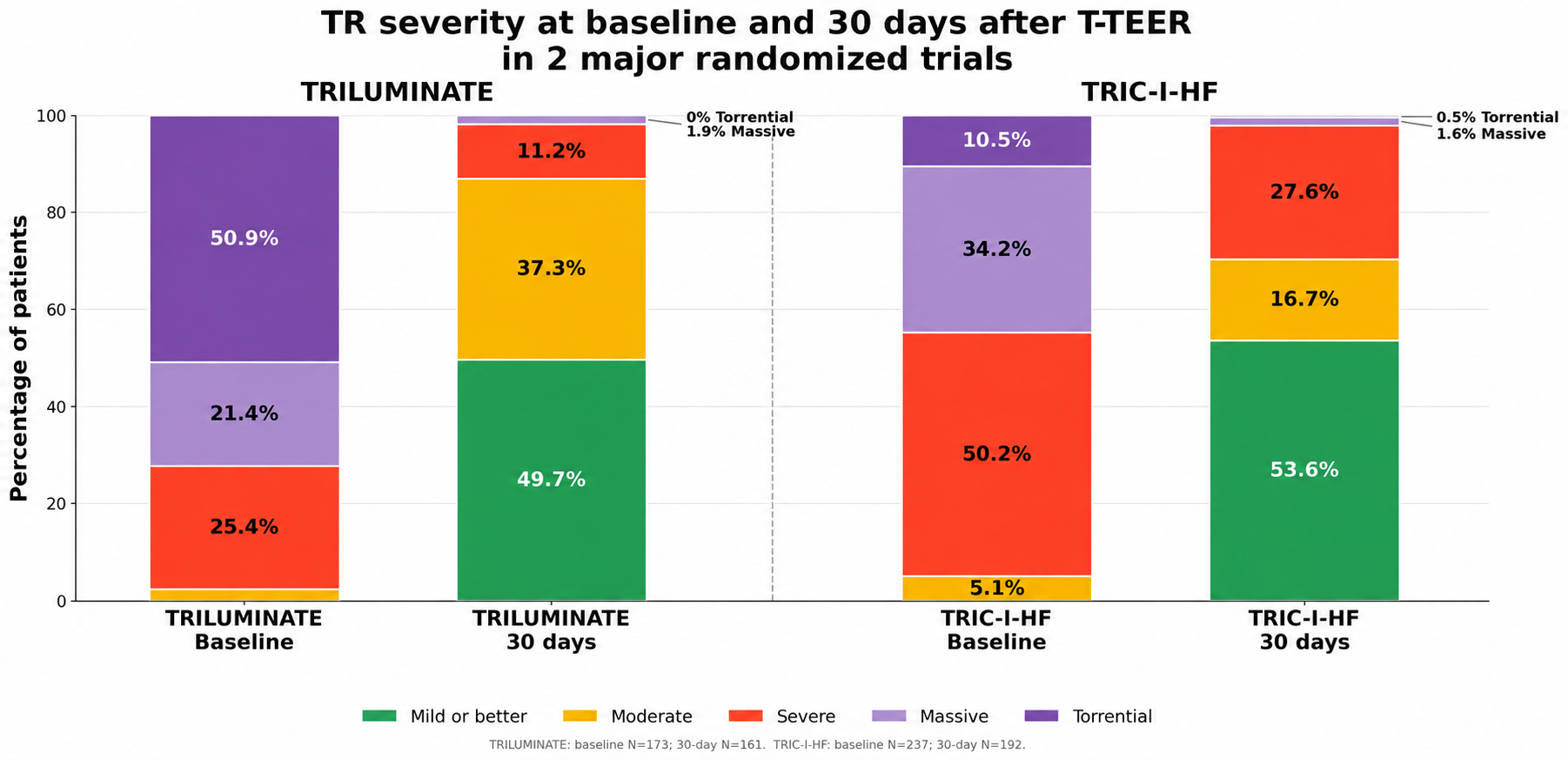
The KCCQ findings point the same way. KCCQ improved by 11.2 points with repair and 4.3 points with medical therapy, a between-group difference of about 7 points.5,10 This is clinically meaningful but not unusually large compared with prior T-TEER trials.1,2 It is difficult to conceptualize why the trial with the largest apparent effect on hard events did not produce the largest effect on TR grade or health status. That weakens a simple explanation based on better operators producing better TR reduction and therefore fewer deaths and hospitalizations. This suggests we need a better mechanism to explain these results.
Beyond quality of life?
TRIC-I-HF is an important contribution, particularly given the effort to enroll a sicker population and describe the treatment paradigm in experienced centers, but the case for a profound reduction in hard clinical events remains less secure. A win-ratio result this large is only as persuasive as the components that drive it. Here, the mortality signal is late and based on sparse follow-up, HFH is intertwined with the crossover pathway, and neither the degree of TR reduction nor the KCCQ response provides a convincing mechanistic explanation for an effect of this magnitude. These limitations do not negate the trial; they constrain what we should conclude from it. At the same time, the presence of any hard-outcome signal, despite crossover of the sickest control patients, offers reason for cautious optimism that T-TEER may do more than improve QOL, and it strengthens the case for T-TEER in patients resembling the TRIC-I-HF population. For now, the most defensible interpretation remains consistent with prior randomized evidence: T-TEER can meaningfully improve QOL in selected patients, while its effect on HFH and survival remains uncertain.