Background
Prasugrel entered the European Society of Cardiology (ESC) Congress 2026 with two distinct questions attached to it: could it replace ticagrelor as the preferred potent P2Y12 inhibitor, and would it support an aspirin-free treatment after percutaneous coronary intervention (PCI).1–6 SWITCH-SWEDEHEART7 and PREMIUM8 tested those claims in very different settings. Both trials were presented at the Congress and published simultaneously in the New England Journal of Medicine.7,8 The first evaluated a health-system prescribing default in unselected acute coronary syndromes (ACS). The second evaluated immediate aspirin omission with reduced-dose prasugrel after primary PCI in East Asian patients with ST-elevation myocardial infarction (STEMI). Neither established the broader claim attached to it. The two trials cannot be combined into one verdict on prasugrel. A health-system prescribing default and an aspirin-free regimen in a selected population address different questions and must be judged against different evidence bases.
Comparative evidence for prasugrel and ticagrelor
TRITON-TIMI 38 and PLATO each established that a potent P2Y12 inhibitor, prasugrel and ticagrelor, respectively, reduced ischemic events compared with clopidogrel at the cost of more bleeding.1,2 The first direct comparison between the two, PRAGUE-18, found no difference at one year (5.7% with ticagrelor versus 6.6% with prasugrel; prasugrel-versus-ticagrelor hazard ratio [HR] 1.17, 95% confidence interval [CI] 0.74–1.84; P = 0.50), though the trial was stopped early for futility and more than a third of patients had switched to clopidogrel for cost reasons by then, so the null result carried limited weight (Figure 1).3 ISAR-REACT 5 was the other head-to-head trial: the composite of death, myocardial infarction (MI), or stroke was lower with prasugrel than ticagrelor (9.3% with ticagrelor versus 6.9% with prasugrel; ticagrelor-versus-prasugrel HR 1.36, 95% CI 1.09–1.70; P = 0.006), without a significant difference in major bleeding.4 Its main limitation is one of strategy rather than pharmacology: ticagrelor was generally given before angiography and prasugrel afterwards, so timing rather than the drug itself may have accounted for some of the difference.

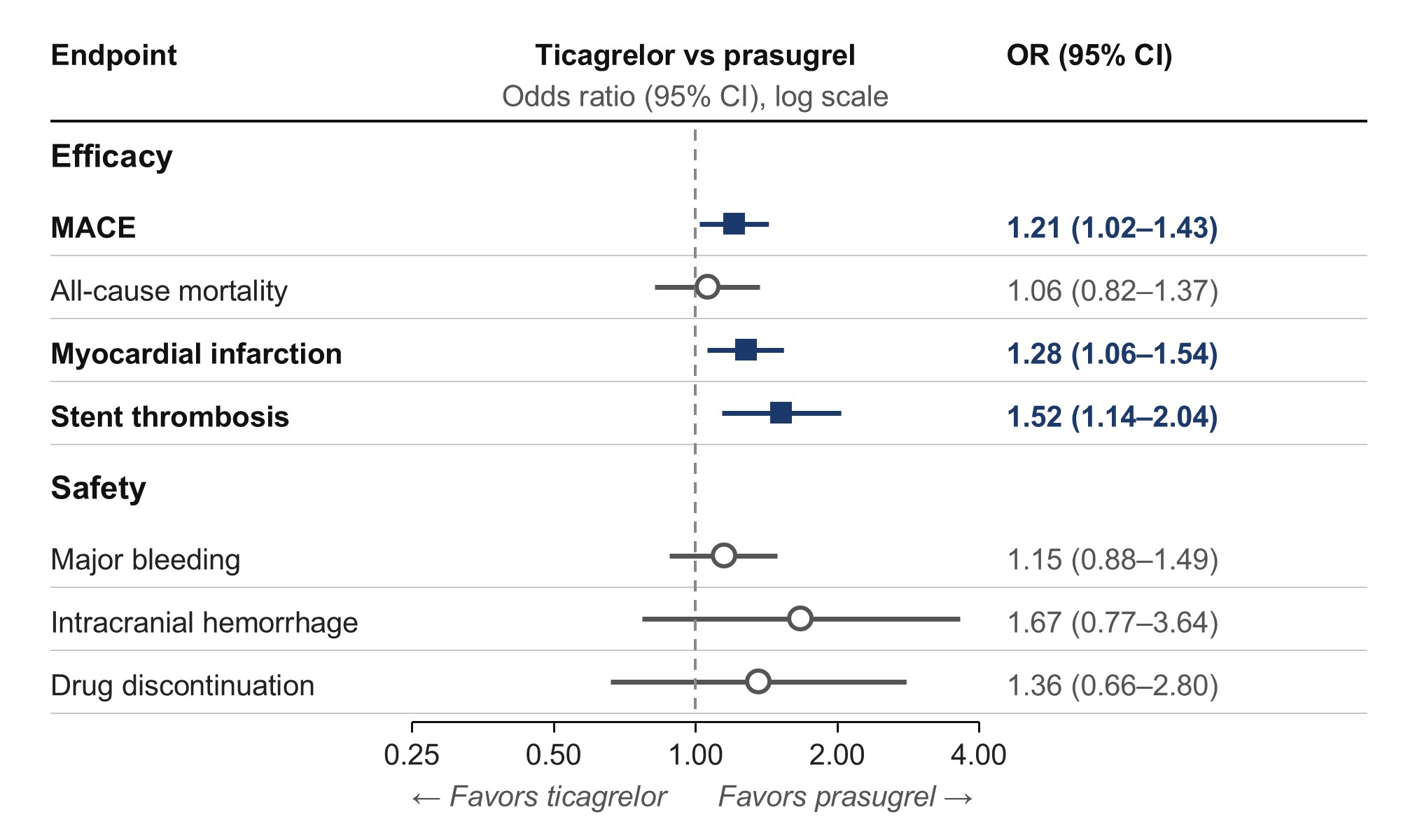
TUXEDO-2 is a more recent addition. In 1,800 patients with diabetes and multivessel disease, ticagrelor failed to meet its prespecified 5% non-inferiority margin against prasugrel for a composite that itself included major bleeding (16.6% with ticagrelor versus 14.2% with prasugrel; risk difference 2.33 percentage points, 95% CI −2.07 to 6.74; P = 0.84 for non-inferiority).5 TUXEDO-2 was inconclusive. Failure of non-inferiority did not establish prasugrel superiority, because the confidence interval included no difference and possible ticagrelor benefit, as with ISAR-REACT 5’s diabetes subgroup (ticagrelor-versus-prasugrel HR 0.84, 95% CI 0.58–1.24; P = 0.38).4
Maqsood and colleagues’ network meta-analysis of 15 trials and 48,904 patients ranked prasugrel first for major adverse cardiovascular events (MACE), MI, and stent thrombosis, against both clopidogrel and ticagrelor.6 The prasugrel-versus-ticagrelor comparison, fed by the same three trials discussed above, was reproduced in the authors’ own direct-comparison meta-analysis, so it does not rest mainly on indirect comparison.6 A more specific caveat: the network showed significant inconsistency for all-cause mortality, at all three treatment comparisons and at the loop level, though not for MACE, MI, or stent thrombosis.6 An accompanying editorial cautioned that the large number of unadjusted confidence intervals should temper confidence in some favorable findings, while still concluding the evidence “tentatively supports” prasugrel as a default P2Y12 inhibitor.9
SWITCH-SWEDEHEART: a health-system implementation trial
SWITCH-SWEDEHEART tested whether making prasugrel the default P2Y12 inhibitor across a health system, in place of ticagrelor, improves outcomes in unselected practice.7 Seven Swedish regions, covering more than half the national population, were grouped into three clusters and stepped sequentially from a ticagrelor default to a prasugrel default between 2021 and 2024, in a randomized order.7 The trial’s premise was that European guidelines already recommend prasugrel over ticagrelor in non-ST-elevation ACS, so it tested implementation of an existing preference rather than a new hypothesis.10
The statistical precision of a stepped-wedge cluster design of this kind depends on the number of clusters, the period structure, and the intracluster correlation, not simply on the number of patients enrolled; with only three randomized cluster sequences, between-cluster variability is estimated from very few units. Treatment is strongly correlated with calendar time by design, making inference dependent on adequate modeling of secular trends. The trial also survived a regulatory challenge: Sweden’s Medical Products Agency halted it over consent requirements, but courts ruled this registry-based policy comparison did not require authorization under EU Regulation 536/2014.7
SWITCH-SWEDEHEART enrolled 17,095 patients: 9,444 under a default ticagrelor policy and 7,651 under a default prasugrel policy.7 The primary endpoint, 1-year death from any cause, MI, or stroke, occurred in 11.8% under the ticagrelor default versus 11.1% under the prasugrel default (prasugrel-versus-ticagrelor adjusted odds ratio [OR] 0.90, 95% CI 0.77–1.06, P = 0.22). The prasugrel-default policy did not demonstrate a statistically significant reduction in the primary composite at population scale. The confidence interval remains compatible with both a clinically meaningful benefit and a modest harm. Observed major bleeding was lower under the prasugrel default: crude rates were 4.4% under the ticagrelor default versus 4.2% under the prasugrel default on the broad International Classification of Diseases, Tenth Revision (ICD-10) definition, and 2.4% versus 2.0% on the narrow definition, with cluster/period-adjusted prasugrel-versus-ticagrelor ORs of 0.80 (95% CI 0.64–0.99) and 0.69 (95% CI 0.50–0.93), respectively. Concordance with the assigned default was substantially lower, and asymmetrically so, under the prasugrel policy: 75.8% of patients who received a P2Y12 inhibitor under the ticagrelor default actually received ticagrelor, against only 60.6% under the prasugrel default, with de-escalation to clopidogrel the dominant deviation in both groups. The trial’s own discussion attributes the null result in part to this non-concordance. Incomplete uptake of an assigned default is, however, part of the real-world effect of changing policy rather than a dilutant of some purer underlying effect, and asymmetric deviation of this kind could bias the estimate in either direction. Because de-escalation to clopidogrel was the dominant deviation, the de-escalation trials are directly relevant. TOPIC and TALOS-AMI switched event-free patients from a potent P2Y12 inhibitor to clopidogrel one month after ACS or MI, HOST-REDUCE-POLYTECH-ACS reduced the prasugrel dose at one month, and POPular Genetics used CYP2C19 genotype to select the inhibitor at primary PCI. Each reduced bleeding without an excess of ischemic events.11–14 These were protocolized strategies in patients who had remained event-free, so they do not show what happens when de-escalation occurs ad hoc under a prasugrel default. The SWITCH-SWEDEHEART discussion also argues that ISAR-REACT 5’s population was younger, at lower risk and more selected, and that the trial compared dosing-timing strategies as much as molecules. These points may no longer hold now that deferred P2Y12 loading is standard practice regardless of agent. They are consistent with the strategy-versus-molecule limitation raised above. The trial refines that limitation rather than resolving it, and it argues for caution, not confidence, in extending ISAR-REACT 5’s direction to unselected, all-comers practice.
PREMIUM: immediate aspirin omission after primary PCI
PREMIUM tested whether prasugrel monotherapy from the time of primary PCI can replace 12-month dual antiplatelet therapy (DAPT) in STEMI, without aspirin.8 The underlying rationale, that sufficiently potent P2Y12 inhibition compensates for the loss of thromboxane blockade, is a hypothesis rather than an established fact, and PREMIUM’s own design complicated it further: the regimen under test was a 20 mg loading dose and 3.75 mg maintenance dose. This is the prasugrel regimen developed for Japanese patients with ACS in the PRASFIT program and approved in Japan,8 and STOPDAPT-3 used it in both of its arms.15 It is a standard East Asian regimen rather than an experimental down-titration. It is, however, around a third of the 10 mg maintenance dose used in Western trials (5 mg for older or lower-weight patients), so the result cannot be assumed to apply to Western dosing.6,8
PREMIUM omitted aspirin from before primary PCI, which is earlier and more complete than any strategy captured in the evidence below: the aggregate meta-analysis’s earliest discontinuation category is up to one month after an initial period of DAPT, not omission from the outset.16 Of 2,280 patients enrolled, 2,268 underwent randomization before primary PCI (12 excluded for ineligibility or duplicate enrollment); the full analysis population excluded a further 52 (44 consent withdrawals, 8 who did not receive the assigned treatment), leaving 1,109 assigned to prasugrel monotherapy and 1,107 to DAPT. The trial was funded by an unrestricted grant from Boston Scientific Japan, with a full independence statement for the sponsor’s role in design, conduct, and reporting.8
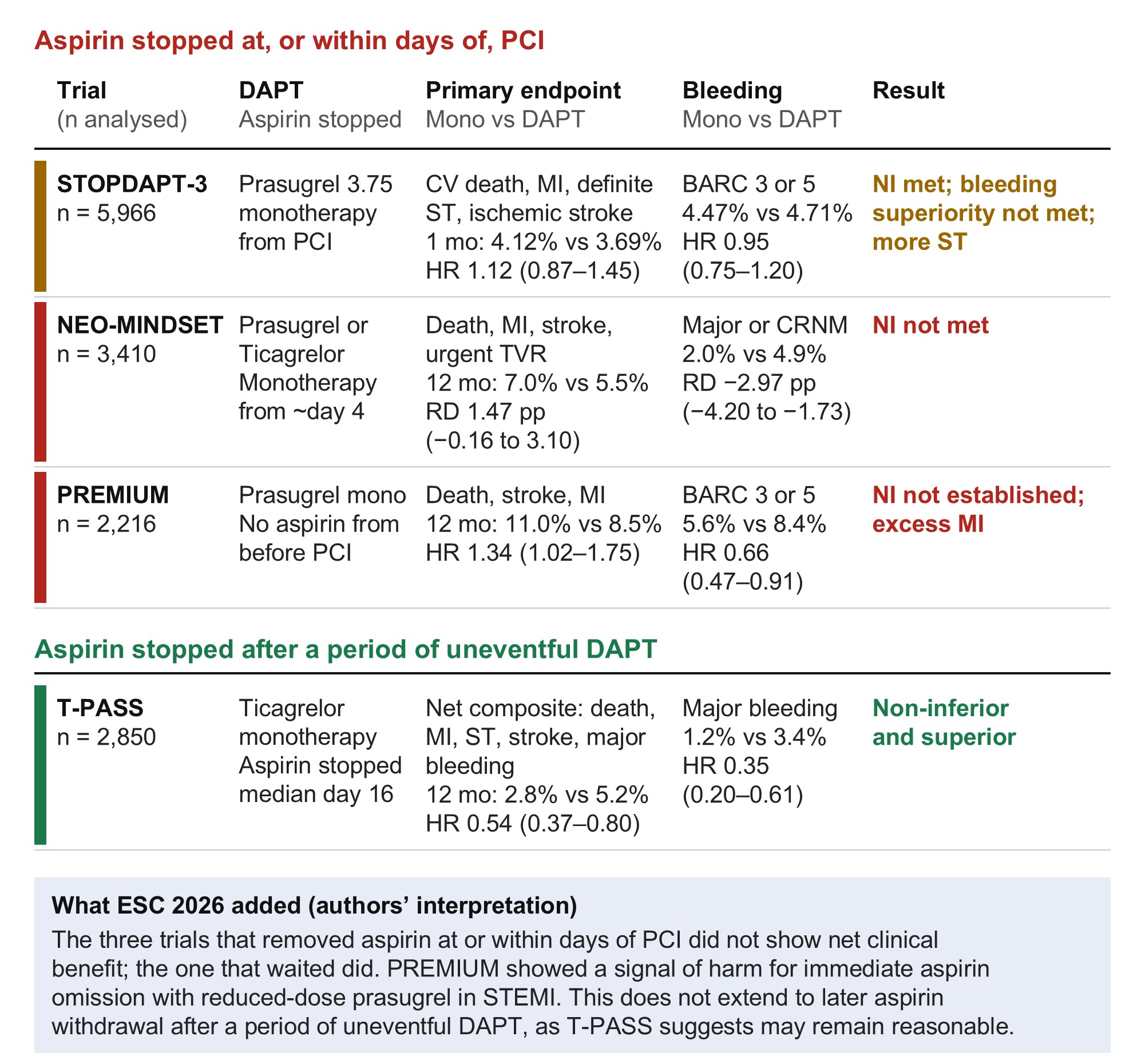
At 12 months, the primary composite of death, stroke, or MI occurred in 11.0% with prasugrel monotherapy versus 8.5% with 12-month DAPT (monotherapy-versus-DAPT HR 1.34, 95% CI 1.02–1.75; P = 0.40 for non-inferiority): the upper confidence bound exceeded the prespecified margin of HR 1.50 – a clinically generous threshold permitting up to a 50% relative excess in the primary composite – so non-inferiority was not established; since the lower bound also exceeds 1, this indicates a higher observed hazard rather than mere failure of non-inferiority. The largest observed component separation was MI (2.9% with monotherapy versus 1.3% with DAPT, HR 2.24, 95% CI 1.19–4.21); definite or probable stent thrombosis was numerically similar between groups (1.4% versus 1.5%, HR 0.94, 95% CI 0.46–1.89). The largest observed differences were in periprocedural and spontaneous MI and non-target-lesion revascularization; the stent-thrombosis estimate was too imprecise to determine its contribution. Observed bleeding (Bleeding Academic Research Consortium [BARC] 3 or 5) was lower with monotherapy than with DAPT (5.6% versus 8.4%, HR 0.66, 95% CI 0.47–0.91), but its prespecified sequential-testing strategy withheld formal superiority testing for bleeding. Per-protocol and safety-population analyses were directionally consistent, though unquantified in the main paper.8 A prespecified 30-day landmark analysis found most of the excess ischemic risk with monotherapy and most of the excess bleeding risk with DAPT within the first 30 days, consistent with prior evidence.16 The trial’s own discussion reaches the same conclusion: aspirin-free strategies may be unsafe when implemented this early after STEMI, and PREMIUM and NEO-MINDSET, both randomizing at or soon after PCI, now show a consistent excess of MI that trials randomizing after a period of uneventful DAPT do not. A reconstructed individual-patient-data meta-analysis of NEO-MINDSET and STOPDAPT-3, the two trials that stopped aspirin immediately after PCI in ACS, found a higher risk of ischemic events at 30 days with monotherapy (HR 1.40, 95% CI 1.11–1.78; number needed to harm 89), with no corresponding reduction in bleeding (HR 0.85, 95% CI 0.67–1.08).17 This is not a positive result for aspirin-free PCI in STEMI. That verdict applies to immediate aspirin omission with this reduced-dose regimen in this population and should not be interpreted more widely.
The same meta-analysis, of 11 trials of P2Y12 inhibitor monotherapy after abbreviated DAPT, comprising 37,443 patients, found similar MACE whether aspirin was stopped within one month or at three months compared with continued 12-month DAPT, with bleeding reduced at both timepoints and more so within one month.16 In ULTIMATE-DAPT, TWILIGHT and TICO, ticagrelor monotherapy after one to three months of DAPT reduced bleeding without an excess of ischemic events.16 In a sensitivity analysis restricted to ACS, however, early aspirin discontinuation carried a higher risk of stent thrombosis, an excess concentrated in discontinuation before one month.16 STOPDAPT-3 is consistent with this pattern. Prasugrel monotherapy from the time of PCI met non-inferiority for the cardiovascular composite against a permissive margin, with a significantly higher rate of subacute stent thrombosis.15 It also failed its co-primary endpoint of bleeding superiority (4.47% with monotherapy versus 4.71% with DAPT at one month; HR 0.95, 95% CI 0.75–1.20), which removes the main rationale for the aspirin-free strategy.15 NEO-MINDSET, testing monotherapy from within four days of PCI, did not meet non-inferiority for the ischemic composite, although bleeding was substantially lower.18 T-PASS is a positive counterpoint: ticagrelor monotherapy after less than one month of DAPT was both non-inferior and superior to 12-month DAPT for the primary composite, driven mainly by less bleeding (Figure 2).19 Read together, these trials suggest that stopping aspirin at or within days of PCI gives up too much ischemic protection, particularly against stent thrombosis. They do not establish how long DAPT must continue before withdrawal becomes safe.

Limits of a prasugrel default
An editorial accompanying Maqsood and colleagues’ meta-analysis already sets out the patient, lesion, and procedural factors that should qualify any default P2Y12 choice, from prior stroke and high bleeding risk to left main disease and the need for oral anticoagulation.9 SWITCH-SWEDEHEART deliberately retained patients with previous stroke and those requiring oral anticoagulation in its primary population, two of the categories that framework flags, and still did not demonstrate a population-level reduction in the primary composite with a prasugrel default; this argues for caution in extending a prasugrel-preference policy to unselected practice, rather than for narrowing the list of exceptions. PREMIUM’s East Asian, imaging-guided, reduced-dose population falls squarely within the limits the framework already anticipates, and its result does not extend beyond that population.
Conclusion
SWITCH-SWEDEHEART and PREMIUM do not deliver a single verdict on prasugrel. SWITCH-SWEDEHEART did not demonstrate a statistically significant reduction in one-year death, MI, or stroke for a prasugrel-default policy in unselected practice; its lower and asymmetric prasugrel uptake limits inference about a forced, individual-patient drug comparison, and its effective information is governed by three randomized clusters and the period structure, not simply by its 17,095 participants. PREMIUM answers a different question more firmly: immediate aspirin omission with 3.75 mg prasugrel after primary PCI in STEMI failed to preserve ischemic benefits, despite lower observed bleeding. These trials therefore support neither a universal prasugrel default nor this specific immediate aspirin-free strategy. They do not, however, resolve the optimal P2Y12 inhibitor for every individual patient, extend PREMIUM’s result to every early aspirin-free strategy, or invalidate later aspirin withdrawal after a period of uneventful DAPT, as T-PASS suggests may remain reasonable. From the totality of evidence, it appears that either generic prasugrel or generic ticagrelor remains a reasonable choice for many ACS patients who have undergone PCI. Aspirin should not be stopped at or within days of PCI. Stopping it after an uneventful first month is supported by randomized and meta-analytic evidence,16 and T-PASS suggests that stopping at around two weeks may be reasonable in selected patients with ACS, although a single trial and the excess of stent thrombosis before one month in ACS argue for caution.16,19 The 2025 American College of Cardiology/American Heart Association (ACC/AHA) guideline recommends ticagrelor or prasugrel in preference to clopidogrel for patients with ACS undergoing PCI without ranking one above the other, whereas the ESC guidelines favor prasugrel.10,20 The 2025 ACC/AHA guideline also recommends the option of transition to ticagrelor monotherapy from one month after PCI in patients who have tolerated DAPT with ticagrelor (Class 1, level A), and regards de-escalation to clopidogrel after one month as may be reasonable (Class 2b).20