
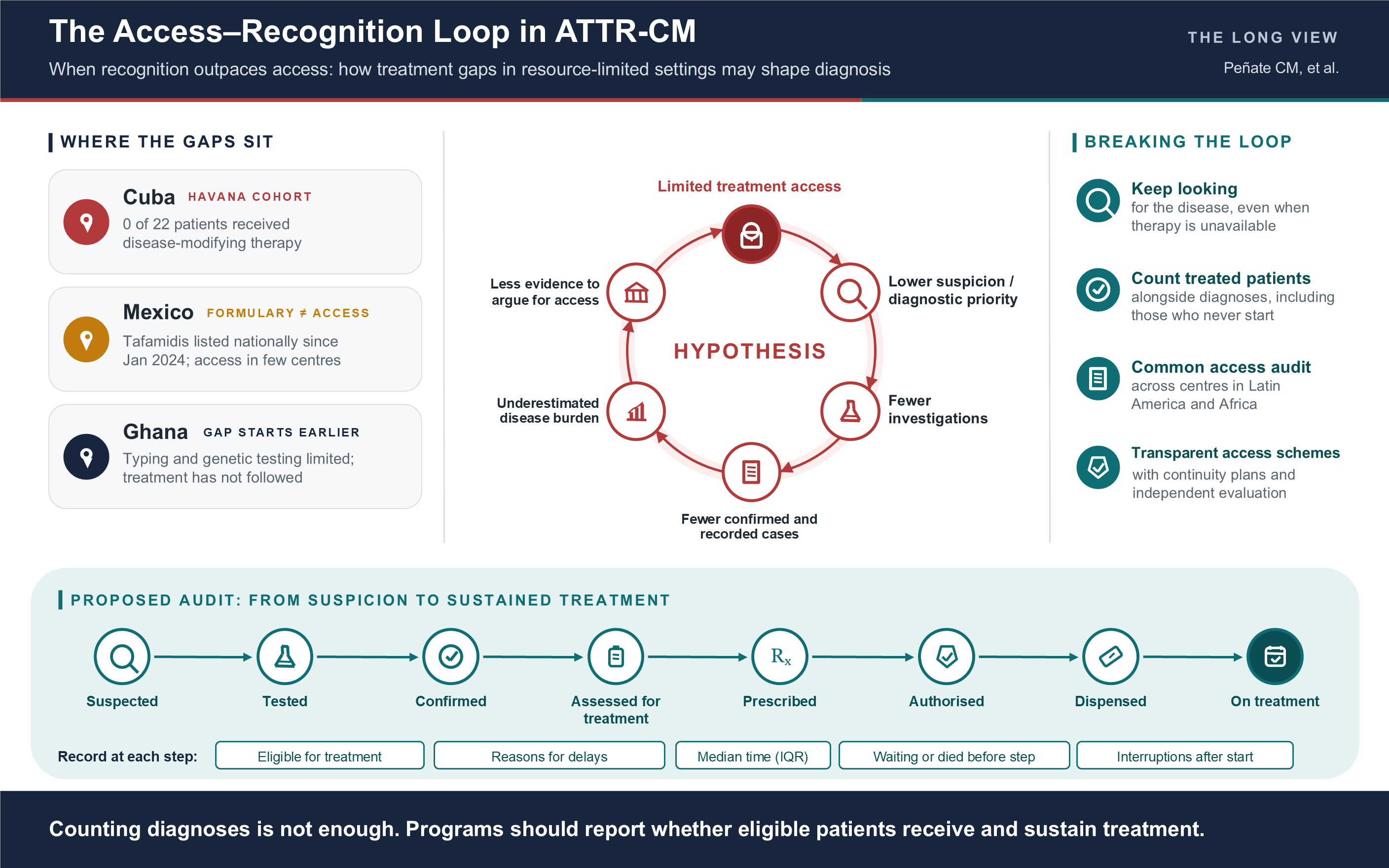
In our published Havana cohort of 22 patients with confirmed transthyretin amyloid cardiomyopathy (ATTR-CM), none received disease-modifying therapy. Nine died during a mean follow-up of 18.2 months.1 What the cohort documents is uncomfortable: in that hospital, in those years, diagnosis and careful follow-up did not lead to disease-modifying therapy which could have affected the longevity of our patients.
Our group spent years building that diagnostic pathway with the resources available to us, bringing together clinical red flags, cardiac imaging and, when we could arrange it, transthyretin gene sequencing. Our published work includes a selected multimodality imaging and genetics series2 and a prognostic analysis.3 We would not undo any of it. Knowing the cause matters to management, and identifying hereditary disease can inform counselling and surveillance. But we no longer think that counting diagnoses is enough to describe what a program has achieved.
This experience has made us wonder whether we look less when disease-modifying treatment is unavailable. In a 2023 survey of 470 physicians in eight Latin American countries, 156 respondents (33.2%) agreed or strongly agreed that ATTR-CM was untreatable.4 That was a minority view, but one held by a third of the sample. Among 406 voluntary AMILO-LATAM respondents, 93% considered a diagnosis of cardiac amyloidosis highly important because it could change management; 7% rated its importance as low because no specific therapy was available. Asked whether cardiac amyloidosis should be investigated in older patients with heart failure and preserved ejection fraction, 53% answered always, 43% sometimes and 4% rarely.5 These are clinicians’ beliefs, not observed practice or patient treatment rates.
We are proposing a loop, not reporting a demonstrated causal sequence. Where effective treatment is out of reach, clinical suspicion may lose priority. Fewer investigations could mean fewer confirmed and recorded cases. With fewer recorded cases, health systems may have less evidence with which to argue for registration, reimbursement or procurement, and access may stay where it was. Our own experience argues against treating that loop as inevitable: we kept looking despite lacking disease-modifying therapy. What a department cannot do alone is place a drug on a national formulary.
The settings represented among these authors illustrate different gaps in diagnosis and access; they are not a representative comparison of three health systems.
In Cuba, the transthyretin-targeted agents were not available to our patients through the national health system, and management was supportive. That is the situation we can document from our own series, in which none of 22 patients received disease-modifying therapy.1 We are not able to document the reasons, and we do not speculate about them here.
Mexico shows a different gap. Tafamidis 61 mg was added to the National Compendium of Health Supplies in the update published on 16 January 2024, for adults with hereditary or wild-type ATTR-CM.6 In C.M.P.’s clinical experience, access is concentrated in a small number of reference centers, including the Instituto Nacional de Cardiología and Centro Médico Nacional Siglo XXI of the Instituto Mexicano del Seguro Social. Patients face lengthy waits, and continuity of treatment is not always assured. These observations describe the settings known to him, not measured national access. A formulary entry, a first dispensing and continued treatment need to be recorded separately.
In Ghana, the pathway is constrained earlier. Dzebu and López Cuba described a small cardiac amyloidosis series in which definitive typing remained a major limitation,7 and a subsequent report described a patient whose scintigraphy was consistent with ATTR-CM but for whom neither genetic testing nor disease-modifying therapy could be obtained.8 Luzzatto named the wider African version of this in 2024: cardiologists there can diagnose amyloidosis, and the medicine has not followed.9
Zavaleta-Monestel and colleagues have already framed cardiac amyloidosis as a health-system problem in the Americas and proposed indicators extending to treatment initiation.10 Our concern builds on that: limited access may influence not only what happens after diagnosis, but whether the disease is suspected and counted at all.
Access mechanisms do exist. Between 2018 and 2023, a sponsor-funded, open-label, noncomparative early-access program started 1,476 patients on tafamidis at 47 centers in 12 countries before commercial availability in their regions.11 Argentina was the only Latin American country represented and no African country took part. The difficulty is not confined to low-resource settings either: an Italian screening model found that cost-effectiveness depended on assumptions including the price of tafamidis.12
There is a clinical reason to pursue access. The Tafamidis in Transthyretin Cardiomyopathy Clinical Trial (ATTR-ACT) showed benefit from tafamidis on its prespecified hierarchical outcome of mortality and cardiovascular hospitalization over 30 months,13 and long-term follow-up of the original randomized groups favored starting at randomization over starting 30 months later.14 Neither tells us what a shorter wait costs. At one expert center in New York, 189 patients completed the route from diagnosis to a first tafamidis dispensing in a median of 65 days (interquartile range, 32 to 124).15 That interval was measurable because those patients reached the end of it; the analysis included only people who were dispensed the drug. In our cohort, no patient received disease-modifying therapy during the observed follow-up. A study can be designed to capture patients who are never prescribed, never authorized or never dispensed.
We would start with a modest audit: of the people in whom ATTR-CM is suspected, how many are tested, confirmed, assessed for treatment, prescribed, authorized, dispensed treatment, and still receiving it at 6 and 12 months? Each transition needs the number progressing out of those eligible and reasons for non-progression. Median times and interquartile ranges among those completing a step should be reported alongside counts of people still waiting or dying before that step. After initiation, interruptions and their reasons also need recording. Genotyping belongs alongside that pathway rather than as a further gate before treatment is considered. Existing records may support a first audit, although unrecorded suspicion and missing dates will limit it, and reliable prospective tracking takes staff time.
For hereditary disease, counselling and surveillance remain useful even when access is uncertain. Expert consensus uses the variant and family history to estimate a predicted age of onset and proposes surveillance beginning 10 years before that estimate, tailored to the individual.16 This estimate guides follow-up; it cannot predict an individual’s exact age at onset, and carrying a variant does not guarantee symptomatic disease. Recognizing disease can inform clinical care even without a disease-modifying drug. The unresolved access question is whether such treatment will be available if disease develops.
In conclusion, if better access encouraged recognition, recorded disease burden might rise. This may lead to increases in testing capacity, referral and awareness. Documenting not only diagnoses but also treatment access over time is required. We call on centers across Latin America and Africa to collaborate on a common audit of treatment access, including patients who never start therapy and those whose treatment is interrupted. Publishing these findings as a consortium could provide a clearer basis for procurement and reimbursement decisions. Health authorities and manufacturers should develop access arrangements with transparent eligibility criteria and plans for continuity, with independent evaluation and publication of access outcomes. We should report whether eligible patients receive and sustain treatment, alongside the diagnoses our programs make.